Discover the life of the lizard: thermoregulation, climate adaptation, and why this reptile is such a remarkable scaly creature in 2026.
De hagedis behoort tot de meest aanpassingsfähige en fascinerende reptielen op onze planeet. Met meer dan 6.000 soorten wereldwijd vormen deze schubdieren een ongelooflijk diverse groep, van minuscule gekko's tot imposante varanen. In 2026 krijgen wetenschappers steeds meer inzicht in hoe deze dieren overleven in veranderende ecosystemen, hoe ze hun lichaamswarmte reguleren en waarom ze zo gevoelig zijn voor klimaatverandering. Voor natuurliefhebbers en reptielenfans biedt het bestuderen van de hagedis een kijkje in de wonderlijke wereld van koudbloedige overlevingsstrategieën. Dit artikel neemt je mee langs de meest verrassende aspecten van het hagedissenleven, van hun unieke thermoregulatie tot hun toekomst in een opwarmende wereld.
De anatomie en diversiteit van de hagedis
De hagedis is een reptiel met een aantal opvallende kenmerken die hem onderscheiden van andere dieren. Het lichaam bestaat uit een kop, romp, vier poten en meestal een staart, waarbij de staart bij veel soorten kan afbreken en regenereren als verdedigingsmechanisme. De huid is bedekt met schubben die bestaan uit keratine, hetzelfde materiaal dat menselijke nagels vormt.
Lichaamsstructuur en aanpassingen
Hagedissen vertonen een enorme variatie in grootte en vorm. De kleinste soort, de dwergkameleon, meet slechts 16 millimeter, terwijl de Komodovaraan wel drie meter lang kan worden. Deze diversiteit weerspiegelt de vele verschillende leefomgevingen waarin hagedissen zich hebben gespecialiseerd.
Belangrijke anatomische kenmerken:
Beweegbare oogleden bij de meeste soorten (gekko's zijn een uitzondering)
Een tong die varieert van eenvoudig tot gevorkt, afhankelijk van de soort
Tympanische membranen (trommelvliezen) die zichtbaar zijn aan de zijkanten van de kop
Vier poten met vijf tenen, hoewel sommige soorten gereduceerde ledematen hebben
De verschillende soorten hagedis hebben unieke aanpassingen ontwikkeld. Kameleons hebben grijpstaarten en onafhankelijk bewegende ogen. Gekko's beschikken over gespecialiseerde teenlamelletjes waarmee ze verticale oppervlakken kunnen beklimmen. Agamen hebben vaak kammen en stekels voor verdediging en visuele communicatie.
Thermoregulation and the cold-blooded existence
As an ectothermic animal, the lizard depends on external heat sources to regulate its body temperature. This fundamental trait determines almost every aspect of its daily life, from activity patterns to territory choice. Recent research in thermal biology shows how seasonal effects shape lizard behavior and physiology.
Strategies for temperature control
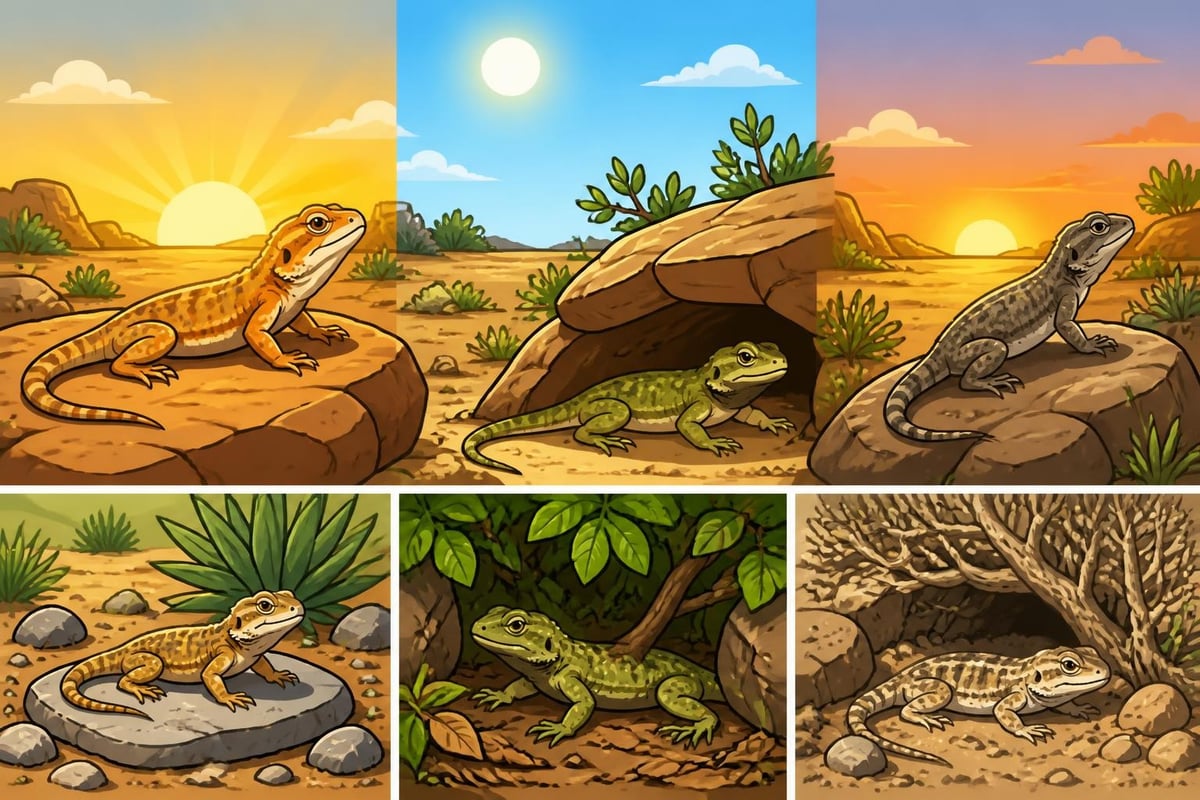
Each lizard species has a preferred body temperature at which its metabolism functions optimally. To reach and maintain this temperature, a lizard uses various behavioral strategies:
Basking: In the morning the lizard seeks sunny spots to warm its body
Seeking shade: At excessively high temperatures the animal retreats to cooler zones
Substrate choice: Selecting warmer or cooler surfaces such as rocks or sand
Time management: Adjusting activity periods to daily temperature fluctuations
A global analysis of climate influences shows how climate shapes functional traits such as body size and thermal physiology in lizards. These insights have become crucial as ecosystems worldwide face pressure.
Thermoregulatory strategy
Function
Example
Postural adjustments
Maximizing or minimizing sun exposure
Pressing body flat against rock
Color change
Adjusting heat absorption
Darkening in cold conditions
Microhabitat selection
Finding suitable thermal zones
Moving to shade or sun
The role of sensory systems
The lizard has refined sensory systems that help it monitor its environmental temperature. Research on sensory integration shows how thermal, visual, and hormonal signals together drive thermoregulation. This integrated approach enables lizards to respond quickly to changing conditions.
Climate change and the future of lizards
Planetary warming has far-reaching consequences for the lizard. As an ectotherm it is particularly sensitive to temperature changes, and scientists already observe measurable effects on populations worldwide in 2026.
Constraints from heat and drought
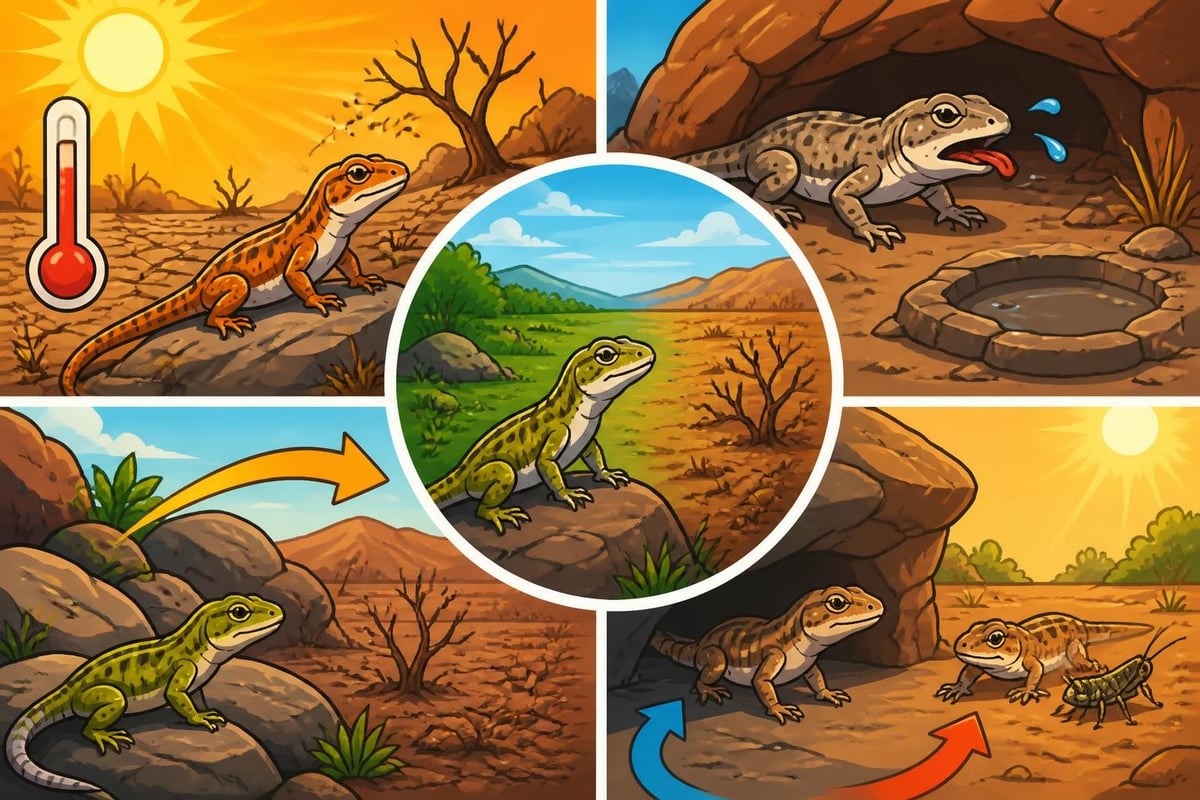
Field observations demonstrate how warming limits lizards' activity periods and raises their energetic costs. When temperatures become too high, a lizard must spend more time in refuges, reducing its opportunities to forage, mate, and defend territory.
Major climate-related threats:
Reduced daily activity time windows
Higher energy costs for thermoregulation
Dehydration due to increased evaporation
Shift of suitable habitats toward higher latitudes or elevations
The problem of dehydration is particularly critical. Research on water balance shows that dehydration impairs thermoregulation and limits lizards' space use. A dehydrated lizard cannot maintain its optimal body temperature, triggering a negative spiral.
Evolutionary and demographic consequences
Broad analyses of climate impacts on ectotherms indicate serious evolutionary and demographic consequences for reptiles including lizards. Populations that cannot migrate or adapt quickly enough face the risk of local extinction.
Conservation status and protection measures
Lizards worldwide face increasing pressure from habitat loss, climate change, and in some cases excessive trade. The IUCN Snake & Lizard Red List Authority continually assesses the threat status of lizard species and publishes updates on which populations need additional protection.
Threats and conservation initiatives
Various factors threaten wild lizard populations:
Habitat destruction: Deforestation, agricultural expansion, and urbanization destroy habitats
Invasive species: Introduced predators such as rats and cats decimate island populations
Illegal trade: Some rare species are captured for the exotic pet trade
Climate change: As discussed earlier, the most comprehensive threat
Positive news also regularly emerges. National Geographic reports, for example, on new species discoveries and successful adaptations to urban environments, showing that some lizards are more resilient than expected.
Conservation strategy
Objective
Effectiveness
Protected areas
Protect habitat
High for sedentary species
Captive breeding
Preserving genetic diversity
Medium, depending on reintroduction
Corridor creation
Facilitating migration
High in fragmented landscapes
Climate refugia
Maintaining stable microclimates
Promising but still under development
The lizard in ecosystems and food webs
Within their ecosystems the lizard fulfills crucial roles that help maintain ecological balance. As mid-level predators and prey they act as a link between different trophic levels.
Ecological functions
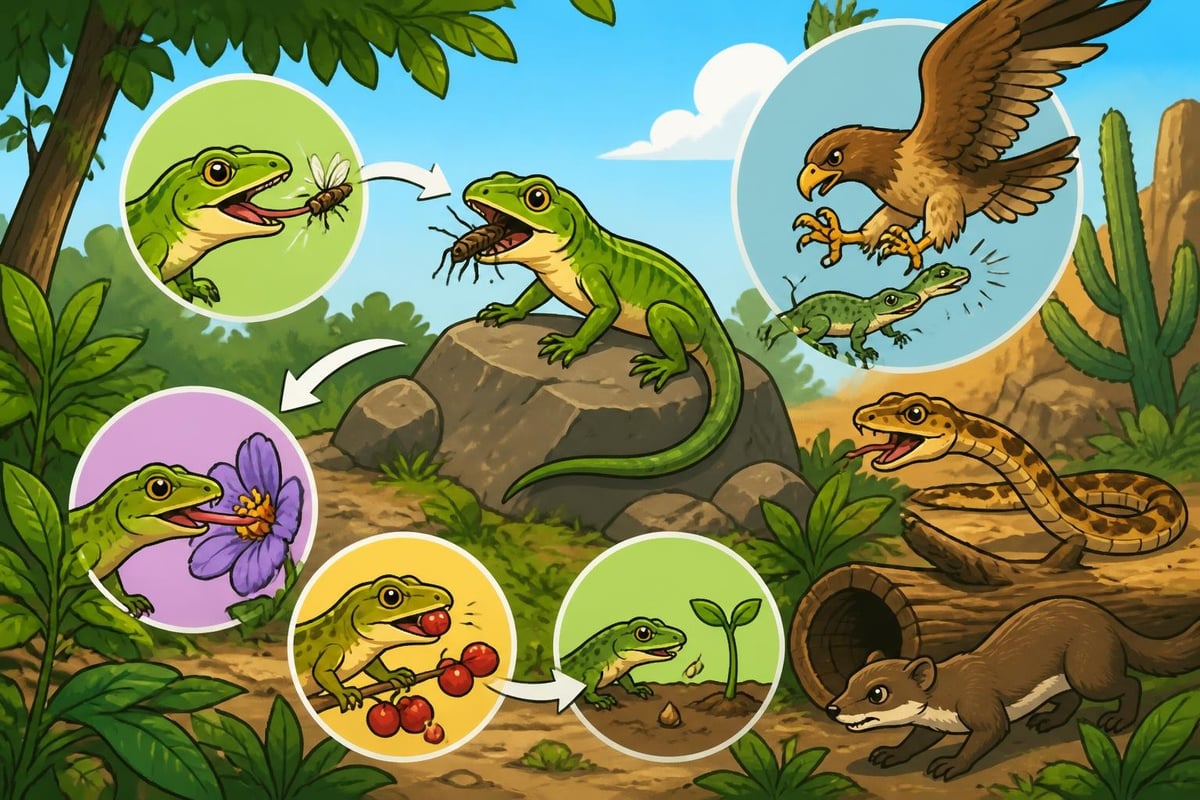
Main ecological roles of lizards:
Regulating insect populations by preying on arthropods
Pollinating plants and dispersing seeds in frugivorous species
Forming prey base for larger predators such as raptors and mammals
Influencing nutrient cycling through their metabolic activity
Many lizard species are specialized predators that consume specific prey. An agamid can eat hundreds of ants per day, while larger species like monitor lizards consume small mammals and eggs. This dietary specialization means that changes in prey density have direct consequences for lizard populations.
Adaptations for hunting and survival
Through evolution the lizard has developed an impressive arsenal of hunting strategies and defensive mechanisms. Some species like chameleons use projectile tongues that are shot out with astonishing speed. Others hunt by waiting motionless and striking suddenly to seize their prey.
Defensive mechanisms are equally varied:
Tail autotomy: Shedding the tail to distract predators
Camouflage: Color adaptation to the environment
Intimidation: Inflating the body, gaping the mouth, displaying bright colors
Escape speed: Some species are among the fastest small reptiles
Reproduction and life cycle
The reproductive behavior of lizards varies greatly between species, but also shows notable common patterns. Most species are oviparous (egg-laying), although some are viviparous (giving birth to live young).
Mating systems and territorial behavior
During the breeding season male lizards often display territorial behavior. They defend areas against rivals through visual displays, showing their brightly colored throat flap or body colors. These displays communicate condition and dominance without physical fighting.
Various mating systems occur:
Polygyny: One male mates with multiple females
Promiscuity: Both sexes mate with multiple partners
Monogamy: Rare in lizards, but occurs in some species
Egg production and parental care
After successful fertilization females lay eggs in carefully chosen locations. Nest site choice is crucial because the eggs are sensitive to temperature and humidity. Some species dig holes in the ground, others lay under rocks or in tree hollows.
The number of eggs ranges from one or two in small species to dozens in large monitors. Incubation time strongly depends on ambient temperature: warmer conditions accelerate development.
Characteristic
Small species
Large species
Clutch size
1-6 eggs
10-50 eggs
Incubation time
30-60 days
60-300 days
Sexual maturity
6-12 months
2-5 years
Lifespan
3-8 years
15-50 years
In most lizard species there is no parental care: once the eggs are laid the female leaves the nest. The young must survive on their own from the moment they hatch. This explains why only a small percentage of hatchlings reach adulthood.
Senses and communication
The lizard has a rich range of senses that help it navigate, hunt and communicate. Although vision is often the dominant sense, chemoreception, hearing and even mechanoreception also play important roles.
Visual communication
Many lizards communicate primarily through visual signals. Color changes, body posture and movement patterns all convey information. Male anoles, for example, perform impressive push-up displays and flare their brightly colored dewlaps to claim territory or impress females.
Important visual signals:
Dewlap displays
Head and bending movements
Color changes
Body inflation
Chemical communication
The lizard also uses chemical signals for communication. With their forked tongue (in some species) or Jacobson's organ they can detect pheromones and other chemical markers. This is especially important for finding mates and identifying territorial boundaries.
Lizards and human culture
Throughout history the lizard has held a fascinating place in human cultures worldwide. From ancient mythologies to modern popular culture, these reptiles stir the imagination.
In many cultures the lizard symbolizes various concepts: rebirth (because of tail regeneration), adaptability, or even good luck. Aboriginal cultures in Australia assign important stories to large lizards in their Dreamtime mythology. In Polynesian traditions geckos are often seen as bringers of good luck.
Modern appreciation and education
In 2026 appreciation is growing for lizards as indicators of ecosystem health. Nature education programs use these accessible reptiles to teach children and adults about biodiversity and conservation.
For people interested in nature calendars and wildlife photography, the lizard offers wonderful opportunities. Capturing their behavior and colors through the seasons can be documented in specially designed nature calendars, such as those available at Kalenderwinkel.nl.
Planning and observation throughout the year
For nature lovers who want to observe lizards, planning is essential. The activity of these reptiles varies greatly by season, making it valuable to record observations in a planner.
Seasonal activity patterns
Spring (March–May): This is often the most active season for lizards in temperate climates. After winter rest they emerge and begin courtship and mating activities. This is the best time for observation.
Summer (June–August): Peak activity, although extreme heat can lead to reduced activity during the hottest part of the day. Early morning and late afternoon are optimal times.
Autumn (September–November): Activity gradually decreases as temperatures fall. Lizards begin preparing for winter rest by foraging intensively.
Winter (December–February): In temperate zones most lizards enter brumation (the reptiles' version of hibernation). In tropical areas they remain active.
For those who want to document these kinds of natural phenomena, a specialized nature calendar can help structure observations. When planning nature excursions and recording sightings, a reliable planner is indispensable, and the wide selection from Kalenderwinkel.nl can provide just that.
The lizard remains one of the most adaptable and fascinating reptiles on our planet, with complex thermoregulation strategies and a crucial role in ecosystems worldwide. For nature lovers who want to plan their observations and nature excursions, Kalenderwinkel.nl offers a wide range of calendars and planners for 2027, so you can record and organize all your nature moments with reliable shipping via PostNL, DHL or UPS.