Discover the enchanting Northern Lights, how they form, and where you can admire this phenomenon. Read why Northern Lights calendars are so beloved.
Few natural phenomena leave as deep an impression as the aurora. Those dancing green, purple, and pink ribbons in the night sky have fascinated people for centuries. I still vividly remember my first encounter with this celestial spectacle during a winter trip to Iceland in 2018. It felt as if the sky itself came alive, a dance of light beyond any description. That experience changed my view of nature forever. The aurora is more than a scientific phenomenon; it is poetry written by the universe itself.
The science behind the aurora
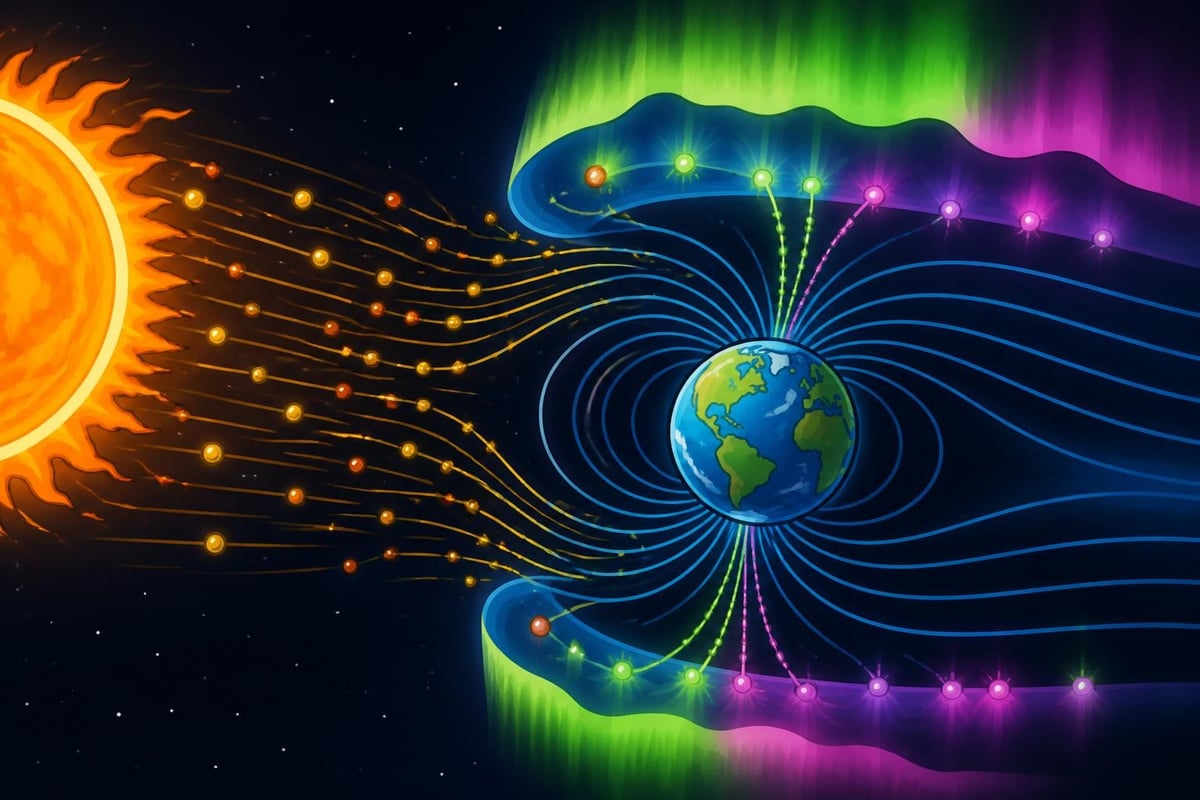
The aurora, scientifically known as the aurora borealis, is the result of a cosmic dance between the sun and our planet. When the sun emits charged particles during solar flares, they travel at tremendous speed through space. Upon reaching Earth they collide with our magnetic field.
This process follows a fascinating sequence of steps:
The sun emits charged particles during solar activity
These particles travel millions of kilometers through space
The Earth's magnetic field guides them toward the poles
In the atmosphere they collide with oxygen and nitrogen molecules
Energy is released as light during these collisions
The colors we see depend on which gas molecules are struck and at what altitude this happens. Green, the most common auroral color, occurs when particles collide with oxygen molecules at about one hundred kilometers altitude. Red light occurs from collisions higher in the atmosphere, while blue and purple come from interactions with nitrogen.
Why only at the poles
The Earth's magnetic field acts as an invisible protective layer. At the magnetic poles this protection is weakest, allowing charged particles to enter the atmosphere more easily. This explains why the aurora is mainly visible in a ring around the North Pole, the so-called auroral zone.
The South Pole experiences the same phenomenon, called the aurora australis or southern lights. Both displays are mirror images of each other and often occur simultaneously.
The best places to see the aurora
Not all locations are equally suitable for witnessing this spectacular light display. The chance of seeing the aurora depends on several factors: geographic latitude, light pollution, weather conditions, and solar activity.
Top destinations for aurora hunters
Destination
Best period
Particulars
Tromsø, Norway
October - March
Polar night, many amenities
Iceland
September - April
Easily accessible, varied landscape
Finnish Lapland
September - March
Glass igloos, authentic experience
Northern Sweden
September - March
Pristine nature, Sami culture
Alaska, USA
September - April
Wild nature, remote locations
Tromsø, where I saw that first aurora, is rightly called the capital of the northern lights. The city sits perfectly in the auroral zone and offers excellent facilities for visitors. But lesser-known places like the Lofoten or the Canadian Yukon also offer spectacular opportunities.
Practical tips for successful northern lights observation:
Choose months with long, dark nights
Avoid periods around the full moon
Check the KP index for forecasts of auroral activity
Seek locations far from artificial light
Be patient and flexible in your planning
Cultural significance through the ages
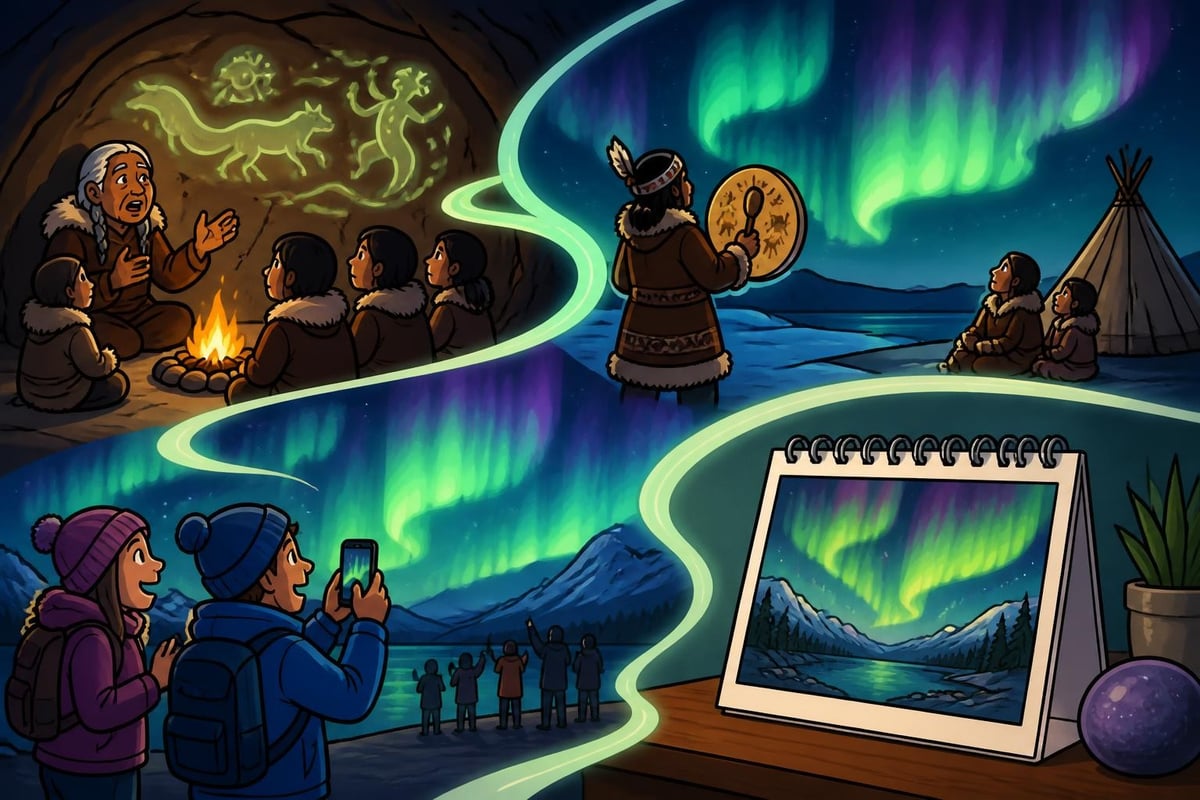
For the indigenous peoples of the north the northern lights were more than a beautiful phenomenon. They were woven into mythology, spirituality, and daily life. The Sami, the indigenous people of northern Scandinavia, believed you should show respect for the lights and not be loud or mock them.
In Norse mythology the auroras were seen as the reflection of the armor of the Valkyries, warrior women who escorted fallen heroes to Valhalla. The Finns called the phenomenon "revontulet", fox fires, based on a legend about a fox that swept its tail through the snow and sent sparks into the sky.
Modern fascination
Today the northern lights draw millions of visitors to the far north every year. This modern pilgrimage has created a whole industry, from specialist tour operators to photography workshops. People put the aurora at the top of their bucket lists.
This fascination also translates into the world of interior design. Aurora calendars are among the most popular wall decorations. They bring the magic of the northern lights into living rooms worldwide, each month offering a breathtaking photo that reminds us of the wonders of our planet.
Photographing the northern lights: art and technique
Capturing the northern lights on camera is an art in itself. What already looks spectacular to the naked eye can become even more impressive in photos. The camera often captures more detail and color variations than the human eye.
Essential camera settings for aurora photography:
ISO: 1600-3200 (depending on lens light-gathering)
Aperture: as wide as possible (f/2.8 or lower ideal)
Shutter speed: 5-25 seconds (depending on movement)
Focus: manual at infinity
RAW format for maximum editing flexibility
A sturdy tripod is indispensable. Even the smallest movement during a long exposure results in a blurry photo. Many photographers also use an intervalometer to avoid vibrations from pressing the shutter button.
From photo to calendar
The most beautiful aurora photos find their way into calendars, bringing them to a wider audience. A well-curated aurora calendar takes you on a visual journey through different seasons and locations. From green curtains above Icelandic waterfalls to purple crowns over Norwegian fjords.
At Kalenderwinkel.nl you can find various calendars that put the beauty of the aurora at the center. These calendars not only offer monthly inspiration but also serve as a daily reminder of the wonders our planet has to offer.
The influence of solar activity
The aurora is not a constant phenomenon. Intensity and frequency vary with the cycle of solar activity, a period of about eleven years. During solar maximum there is more activity, resulting in more intense and frequent auroras that can be visible at lower latitudes.
In 2024 we were in an active phase of the solar cycle, which led to spectacular displays. Even in countries like the Netherlands and Belgium, faint auroras were occasionally seen, something normally rare.
Forecasting and planning
Modern technology makes it possible to forecast aurora activity with reasonable accuracy. Scientists continuously monitor solar activity and can warn when large solar flares are directed toward Earth.
Key indicators for aurora hunters:
KP index (0-9, with higher meaning better chances)
Solar wind speed
Cloud cover forecasts
Moon phase and set time
Apps and websites provide real-time updates, allowing you to plan your evening around the best opportunities. Still, there is always an element of unpredictability, which is part of the magic.
Aurora in different seasons
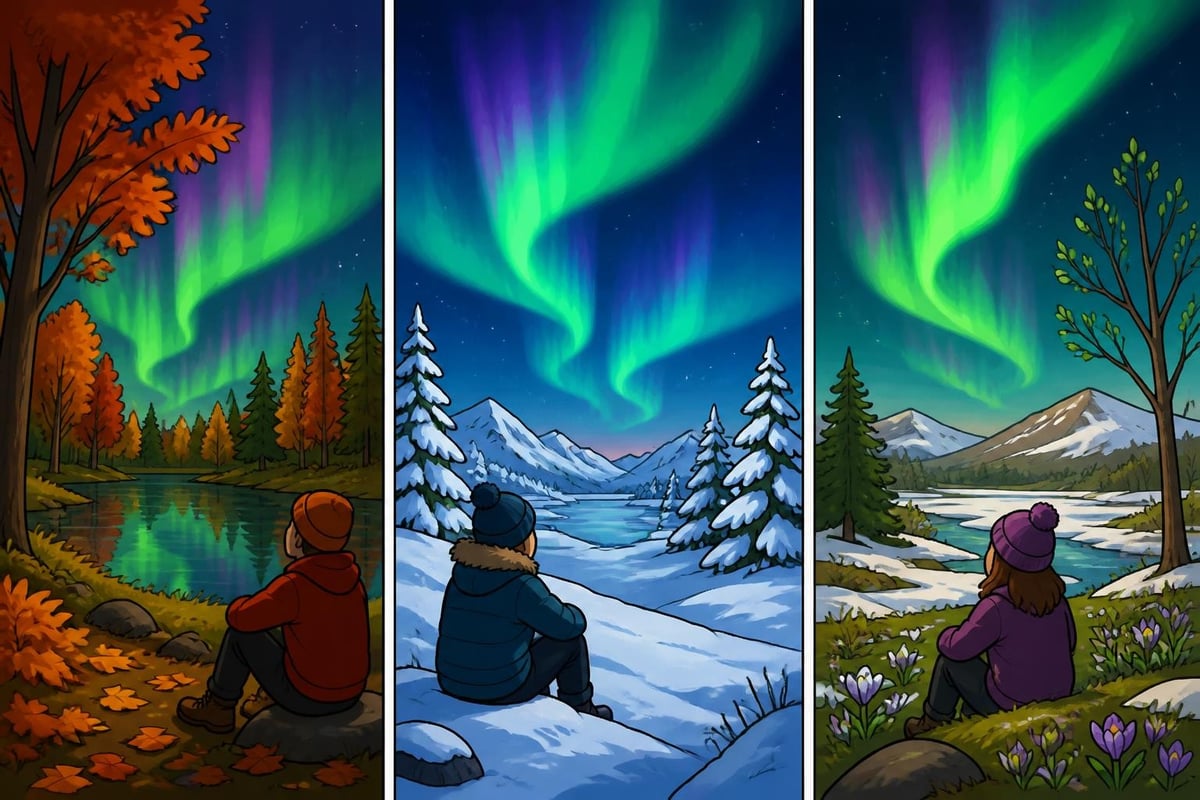
Although the aurora is technically active year-round, the long summer days in the high north are not dark enough to see it. The best period runs from September to April, with each season having its own charm.
Autumn: the start of the season
September and October often offer the first opportunities after the summer months. Temperatures are relatively mild, and the landscapes show beautiful autumn colors. The contrast between golden birches and green skies creates special photo opportunities.
Winter: the peak
December to February offers the darkest nights and thus the best chances for sightings. The polar night in places above the Arctic Circle means it barely gets light during the day, creating longer observation windows. The snowy landscape reflects the aurora, bathing the surroundings in an ethereal glow.
Spring: the final dance
March and April mark the end of the season. Temperatures rise and days get longer. Still, these months can offer spectacular displays, especially around the equinox when geomagnetic activity often increases.
The economic impact of aurora tourism
The aurora has grown into a significant economic engine for northern regions. Small villages in Lapland, Norway and Iceland have adapted their infrastructure to accommodate the annual influx of tourists.
Aspect
Impact
Accommodations
Specialized aurora resorts and glass igloos
Employment
Guides, photographers, transport services
Season extension
Winter tourism as an economic pillar
Cultural exchange
More attention to indigenous cultures
This development has also brought challenges. Popular locations suffer from overtourism, and there is growing concern about the ecological footprint. Local communities are seeking a balance between economic benefits and sustainability.
Aurora at home: calendars and art
For many, a trip north is not feasible. Luckily, aurora calendars bring a piece of that magic home. Each month a new breathtaking photo that reminds you of the grandeur of nature.
Benefits of an aurora calendar:
Daily visual inspiration
Educational for children about natural phenomena
Conversation topic with visitors
A calm point in a busy world
Motivation for future travels
A wall calendar with nature photography can be transformative in a space. The color palettes of the northern lights, from subtle greens to intense magentas, add dimension to any interior.
When choosing an aurora calendar, it's important to pay attention to photo quality and print. Professionally photographed images, printed on high-quality paper, do greater justice to the true beauty of the phenomenon.
Scientific research and the future
Despite centuries of observation, the northern lights still give scientists new insights. Recent research has identified new forms and patterns, each with its own name. "STEVE" (Strong Thermal Emission Velocity Enhancement) is a purple ribbon that doesn't fit traditional aurora categories.
Satellite missions and ground stations continuously collect data on solar activity and geomagnetic storms. This information not only helps predict auroras but also protects technology. Strong geomagnetic storms can disrupt communication systems, GPS, and power grids.
Climate change and the northern lights
A question that regularly arises is whether climate change affects the northern lights. The phenomenon itself is primarily determined by solar activity and the Earth's magnetic field, not by climate. However, increased cloudiness in certain regions can affect visibility.
Personal stories of aurora chasers
Everyone who has seen the northern lights has their own story. A colleague told me about her experience in Finnish Lapland, where she stood for hours in the freezing cold waiting. Just as she was about to give up, the sky exploded into a dance of green and purple. The tears that ran down her cheeks froze instantly, but she didn't even feel them.
Another story comes from a photographer who traveled north for years without success. Clouds, bad timing, weak activity. On his seventh attempt, almost ready to give up, he experienced the strongest aurora storm in twenty years. He described it as the universe rewarding his perseverance.
These stories illustrate that the northern lights are more than a visual spectacle. They connect people to something larger, something that reminds them of their small place in a vast universe.
Northern lights and mindfulness
In our hyperconnected world, the northern lights offer a rare chance for a digital detox. To see them, you must travel to remote places, often far from Wi‑Fi and mobile coverage. You stand in cold and darkness, fully present in the moment.
This experience has meditative qualities:
Forced slowing down and patience
Connection with nature
Perspective on everyday worries
Shared silence with fellow observers
Moment of pure wonder
Many people describe seeing the northern lights as a spiritual experience, regardless of their religious background. It confronts you with the majesty of natural forces that have existed for billions of years and are infinitely greater than human concerns.
For those who want to relive this experience or create a moment of calm each day, a northern lights calendar can serve as visual meditation. A moment to pause, breathe, and remember what truly matters.
Plans for 2027
With 2027 approaching, it’s time to look ahead. The solar cycle is moving into an interesting phase, which is promising for aurora hunters. If you’re planning a trip, booking early is recommended. Popular accommodations in the auroral zone fill up months in advance.
A northern lights calendar for 2027 can help build anticipation. Months of looking at those stunning images mentally prepare you for your own adventure. It acts as a visual bucket list, a daily reminder of dreams waiting to be fulfilled.
At Kalenderwinkel.nl you’ll find a selection of calendars that capture this natural beauty, so you can enjoy this special phenomenon all year long.
The northern lights remain one of the most accessible yet profound natural experiences our planet offers. Whether you plan a trip north or want to experience the beauty at home, the magic is just as powerful. At Kalenderwinkel.nl you’ll find various 2027 calendars that bring these natural wonders to life year-round, with convenient payment options and reliable shipping. Get inspired and bring a piece of the far north into your own space.