Sinterklaas is the Dutch children's celebration on December 5th. Read about where it comes from, how it is celebrated, and which traditions belong to it.
Sinterklaas is a Dutch children's festival centered on Saint Nicholas, a fourth-century bishop regarded as the protector of children. Every year he arrives in the Netherlands in November, children put out their shoes, and on December 5th, Pakjesavond, gifts are distributed, often with a poem. The celebration is a mixture of a medieval church tradition, folk customs and a nineteenth-century invention that shaped the modern children's festival.
If you ask a child in 2026 what Sinterklaas is, you will get a different answer than if you ask a historian. For the child he is the kindly saint on his horse; for the historian he is an age-old stream of stories that travelled from Turkey via Italy to the Low Countries. Both answers are correct, and that makes the festival so enjoyable to unravel.
What is the origin of Sinterklaas?
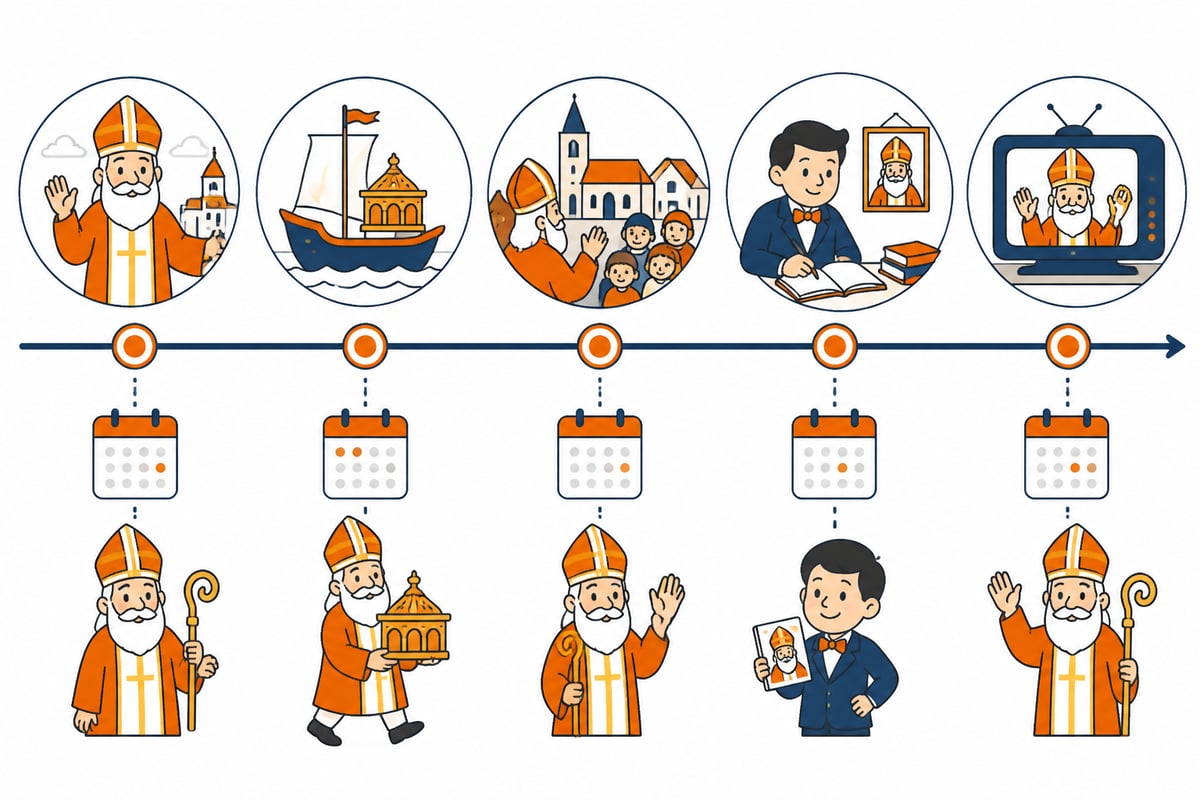
The origin of Sinterklaas lies with Nicholas, traditionally the bishop of Myra, in present-day Turkey, in the fourth century. His existence is plausible, but contemporary sources that confirm it are lacking, as National Geographic writes. What we know about him therefore comes from legends recorded centuries later.
Those legends tell of a generous man. He is said to have helped a poor father with three daughters by throwing gold through the window at night so the girls could marry. He also allegedly saved three men wrongfully condemned and brought children back to life. Thus Nicholas became the patron saint of children, sailors and merchants.
After his death the veneration grew. In 1087 his relics were moved from Myra to Bari in Italy, and from that moment veneration in Western Europe increased sharply. Churches, chapels and cities chose him as patron. Amsterdam did too: the Saint Nicholas Church by Central Station still recalls this.
The National Library discusses in a blog about the KB collection the historical Nicholas, the medieval celebrations and how the festival developed in the Netherlands.
How did the celebration originate in the Netherlands?
The Sinterklaas celebration in the Netherlands originated from medieval observances of Nicholas, during which children already received gifts. Dutch archives show the celebration of Saint Nicholas in Dordrecht as early as the fourteenth century, according to the Rijksmuseum.
Notably, some customs are very old. Putting out shoes and handing out pepernoten already occurred in medieval celebrations, which were then also celebrated in the streets. What children now do with a carrot and a drawing for the horse therefore began long ago as a gesture of piety and generosity.
After the Reformation the festival came under pressure, since Protestants had little sympathy for saint veneration. Yet it did not disappear. It retreated into the home and increasingly became a family celebration, less a church festival. That move from the street to the home is what created the children's celebration we know today.
What does Sinterklaas actually look like and who is the man behind him?
Sinterklaas wears a red mitre and a red bishop's cloak, holds a staff, and rides a white horse—features that go directly back to Bishop Nicholas. So there is a double answer to the question of who the man behind Sinterklaas is: historically he is the Bishop of Myra; in the story he is a Spanish bishop with his own boat, horse, and retinue.
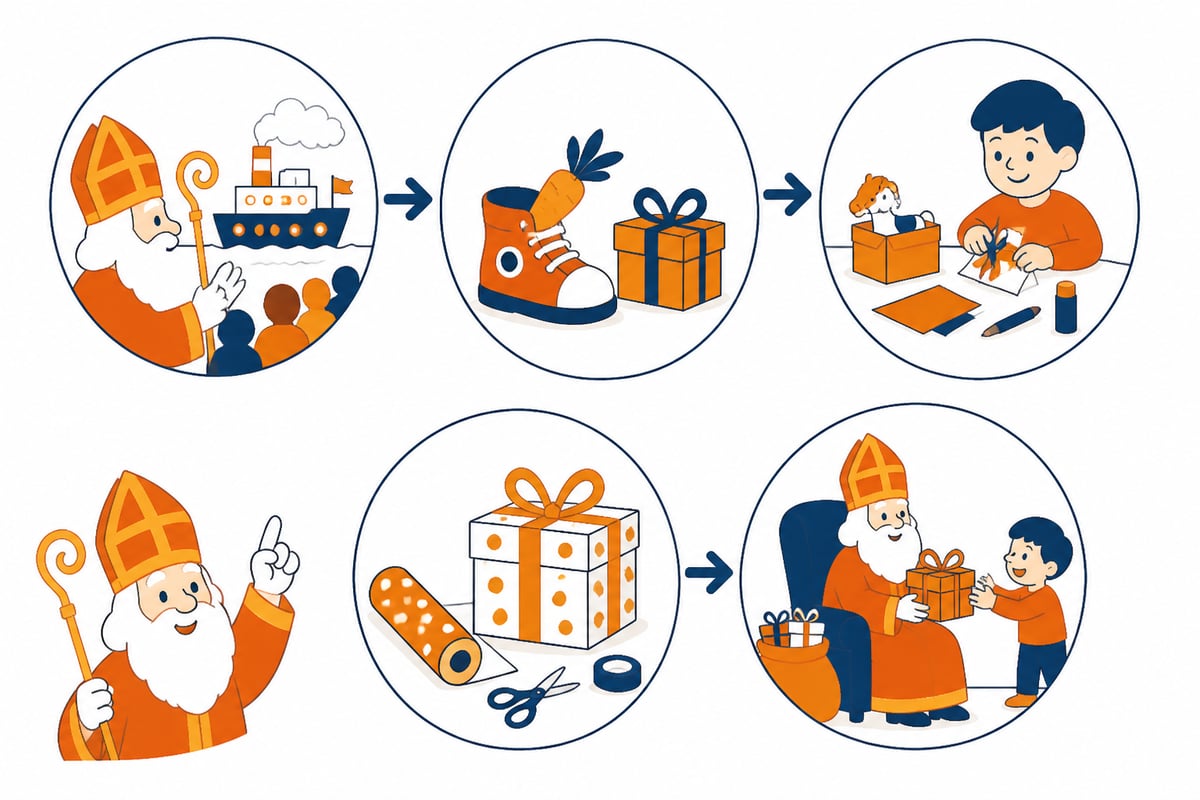
Spain's place in the story comes from Jan Schenkman. He published a children's book in 1850 that laid the foundation for elements of the modern celebration, including the steamboat tradition, according to National Geographic. From then on Sinterklaas arrived by steamboat, with his helpers on board. That image became so strong that it is still reenacted in many places.
The man in the costume is in practice an actor or a disguised neighbor, uncle, or father. At schools and shopping centers this is a small, endearing secrecy that adults carefully preserve. The public Sinterklaas story even has its own form of secrecy: each year those who help and the role distribution are announced, and until the arrival it often remains a well-kept secret.
The Sinterklaas traditions at a glance
The main Sinterklaas traditions are putting out shoes, Pakjesavond with surprises and poems, the arrival parade, and singing the songs. Together they form a set routine that is followed in almost every Dutch household in its own way.
The arrival: Sinterklaas arrives in November in a Dutch town, and the arrival has been broadcast on television since 1952, as DutchNews reports.
Putting out the shoe: children leave a drawing, a carrot or hay by the chimney or heater and find something tasty the next morning.
Pakjesavond: on 5 December someone rings the doorbell, there is a sack on the step, and presents are unwrapped.
Surprises and poems: a homemade gift with a rhyme, often very humorous and with a touch of teasing.
Sweets: pepernoten, kruidnoten, taaitaai, marzipan and chocolate letters.
The Sinterklaas Journal: the daily children’s program that accompanies the weeks until pakjesavond.
A chocolate letter in the shoe is a small ritual in itself. Many families choose the initial letter of the name; some children receive double letters if they were extra good. Such small agreements make the celebration personal.
How is Sinterklaas celebrated in Germany and other countries?
In Germany Sinterklaas is celebrated as Nikolaustag on 6 December, the day the bishop is said to have died according to the calendar. Children put their boots or shoes outside the door the evening before, and in the morning they contain sweets and small presents. It is modest and mainly focused on the morning, without a big pakjesavond.
Saint Nicholas is also loved elsewhere:
Country
Date
How it works
Germany
6 December
Boots or shoes for the door, sweets and small presents
Belgium
6 December
Sinterklaas arrives with presents; similar customs to those in the Netherlands
Austria
5 and 6 December
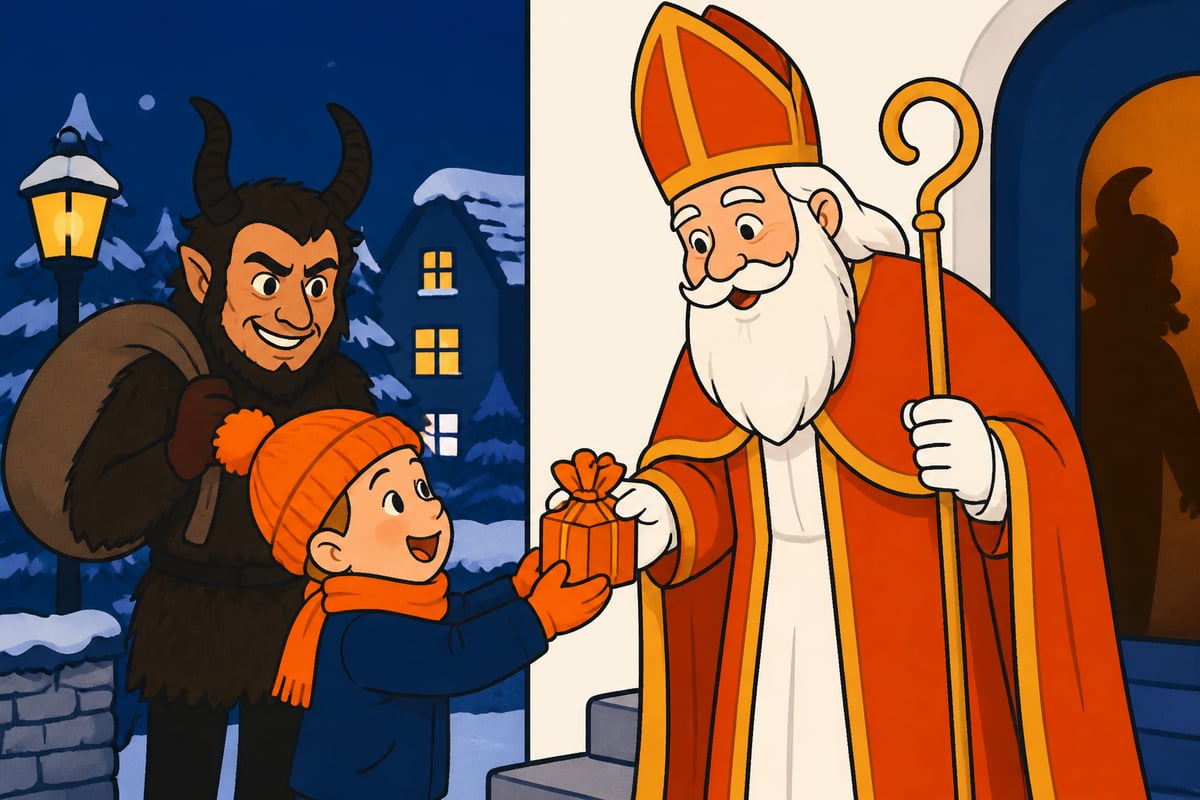
Nikolaus brings sweets; in some regions Krampus figures also join
Czech Republic
5 December
Mikuláš goes around with an angel and a devil
Italy (Bari)
6 and 9 May
Feast around the relics of the saint
The difference with the Netherlands is mainly one of scale. Where the Netherlands makes a whole season of it, with television, arrivals and surprises, in many neighboring countries it stays to one day and one shoe.
Sinterklaas in your own home: a week-by-week plan
Those who want to celebrate Sinterklaas at home enjoy a calendar that makes the weeks until pakjesavond visible. A schedule keeps the celebration relaxed: the arrival in November, the shoe moments, the surprise evening and the final presents each have their own spot.
A simple layout:
Mid-November: watch the arrival together and agree when to put out the shoe.
First week of December: plan surprises and name-draws, and write the poems.
Just before pakjesavond: check presents, cards and wrapping.
Evening of December 5th: set the mood with candles, songs, and pepernoten.
After the celebration: keep a nice drawing or poem as a memento.
A calendar on the kitchen wall works for children as a countdown calendar. You can cross off days, talk about what’s coming, and keep the schedule for the festive month together. A beautiful art calendar, for example the Vincent van Gogh calendar 2028 or the Masters of Painting calendar 2027, instantly makes family planning a pleasant spot in the home.
Nice gifts and games for Sinterklaas
A good Sinterklaas gift is personal, surprising, and not too big. For Sinterklaas evening itself there are puzzles, activity books, and small cards that together can fill an evening.
For someone looking for a small item to add to a poem, there are note cards such as the Hummingbird Garden note cards. And anyone already thinking about the new year can consider a 2027 calendar or planner as a gift, like the Stitch 2027 planner for a child who has a favorite character, or The Nightmare Before Christmas 2027 A5 planner for a teen with quirky taste.
A gift that remains visible all year has something valuable: each month you think again about who gave it. That's exactly what a calendar does, which is why it fits so well with the Sinterklaas season.
Sinterklaas and the transition to December and the new year
In the Netherlands Sinterklaas marks the start of the dark months, and many families use the celebration as a stepping stone toward Christmas and New Year’s. Pakjesavond falls on 5 December, a few weeks before Christmas, and in the meantime cards are written, gifts are thought up, and plans are made for the months ahead.
That makes December a natural time to look ahead. If you still have time before 5 December, you can already search for a calendar for the new year, a planner for the coming months, or Christmas cards for family and friends. There are Christmas card sets such as the 12 luxury Woodland cards, suitable for filling the short months between Sinterklaas and New Year.
Those seeking a calm atmosphere can also find inspiration in a green spot, a cup of coffee, and a lovely bakery around the corner. A Venetian bakery cafe like Farini shows how artisanal pastries can create a festive mood, while Divine Roots supplies winter greenery for indoors to bring a homely festive month.
FAQ
What is Sinterklaas’s new crew?
Each year Sinterklaas’s public story gets a new lineup of helpers and collaborators, usually announced only shortly before the arrival parade. Names and roles change yearly, so the exact lineup for 2026 is best found in the official announcements around the national arrival.
Why is Sinterklaas celebrated on 5 December?
According to tradition Nicholas died on 6 December, and the celebration around his deathday has long been held on that date. In the Netherlands the gift-giving moment shifted to the evening before, pakjesavond.
Is Sinterklaas the same as Santa Claus?
No, they are two separate figures who do share the same roots. Santa Claus developed later, partly from the image of Nicholas that was adopted and adapted in America. In the Netherlands the two celebrations remain clearly separate: Sinterklaas in November and December up to 5 December, and Christmas on 25 and 26 December.
Mark 5 December in your calendar today and make a short list of who you want to give a gift, card, or poem. A nice calendar or planner for 2027 is a gift that will remind them all year. At Kalenderwinkel.nl you can browse the full range of calendars, planners, and cards at your leisure, with reliable shipping via PostNL, DHL, or UPS.