Discover the fascinating life of the squirrel, from their acrobatic jumps to winter foraging. Learn how to help these agile rodents.
It was a gray October morning when I saw from my kitchen window a squirrel working in the beech tree. With lightning-fast movements the animal dug holes in the garden, put an acorn in each one and carefully covered the hole again. What I didn't know: that squirrel was engaged in one of the most impressive survival strategies in nature. The story of the squirrel is one of adaptability, intelligence and a constant struggle to survive in a changing world. These agile rodents not only conquer our gardens but also our hearts. And as we become more aware of our natural environment in 2026, the squirrel deserves our attention and care.
The squirrel as architect of the forest
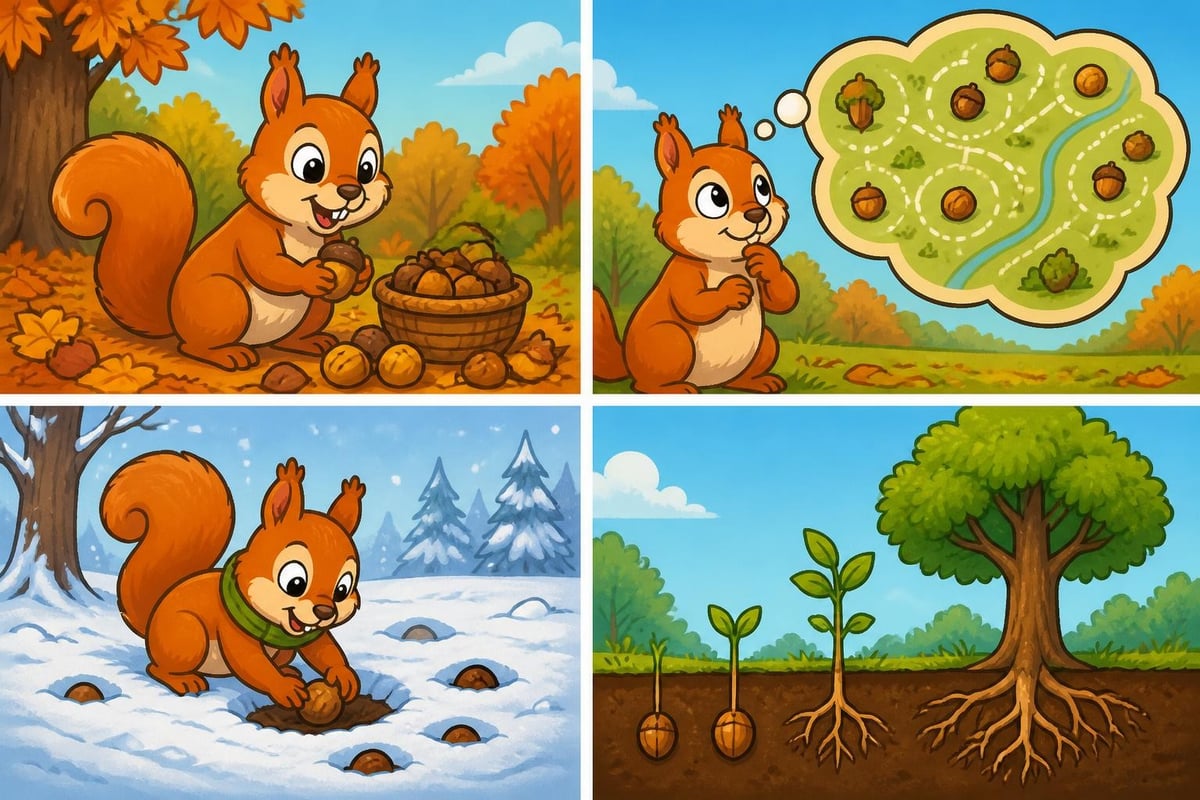
The squirrel's role in our ecosystem is often underestimated. These small forest dwellers are literally tree planters on a mission. When a squirrel is busy in autumn collecting nuts, acorns and beech nuts, the animal sometimes hides thousands of food caches spread across an area of several hectares.
Why is this so important?
An average squirrel forgets about 25% of its food caches
Those forgotten seeds grow into new trees
In this way squirrels help with natural reforestation
They contribute to the spread of tree species over greater distances
A squirrel's memory does not work like a human's. They use a combination of spatial memory and scent to retrieve their hidden caches. During my years as a nature enthusiast I have seen a squirrel in the middle of a snowy garden precisely dig in the spot where a hazelnut had been buried months earlier. That precision is breathtaking.
Anatomy of an acrobat
The physical abilities of a squirrel are nothing short of spectacular. Their body is a perfect example of evolutionary engineering:
Feature
Function
Performance
Hind legs
Jumping power
Jumps up to 6 meters
Tail
Balance and communication
Acts as rudder and parachute
Claws
Climbing
180° rotation for descending
Eyes
Panoramic vision
Almost 360° field of view
Their tail may be the most underrated body part. This fluffy tail serves as a blanket in winter, as a parasol in summer, as a balancing tool during acrobatic jumps and even as a means of communication to other squirrels. When you see a squirrel with a twitching tail, you are witnessing a complex signal that can range from a territorial warning to readiness to mate.
Red versus gray: A European drama
The interaction between native red squirrels and invasive grey squirrels is one of the most discussed ecological challenges in Europe. In the Netherlands we are fortunate that our red squirrel is still relatively safe, but in countries like Great Britain and Italy the story has a tragic twist.
The grey squirrel has several competitive advantages:
Larger body size and weight
More efficient at digesting tannin-rich acorns
Carrier of the parapoxvirus (deadly to red squirrels)
More aggressive territorial behavior
In 2025 an Italian study on rapid eradication reported the successful elimination of a small grey squirrel population. Such interventions are crucial, because once established populations are nearly impossible to remove. The European invasive species legislation provides a legal framework for prevention and management.
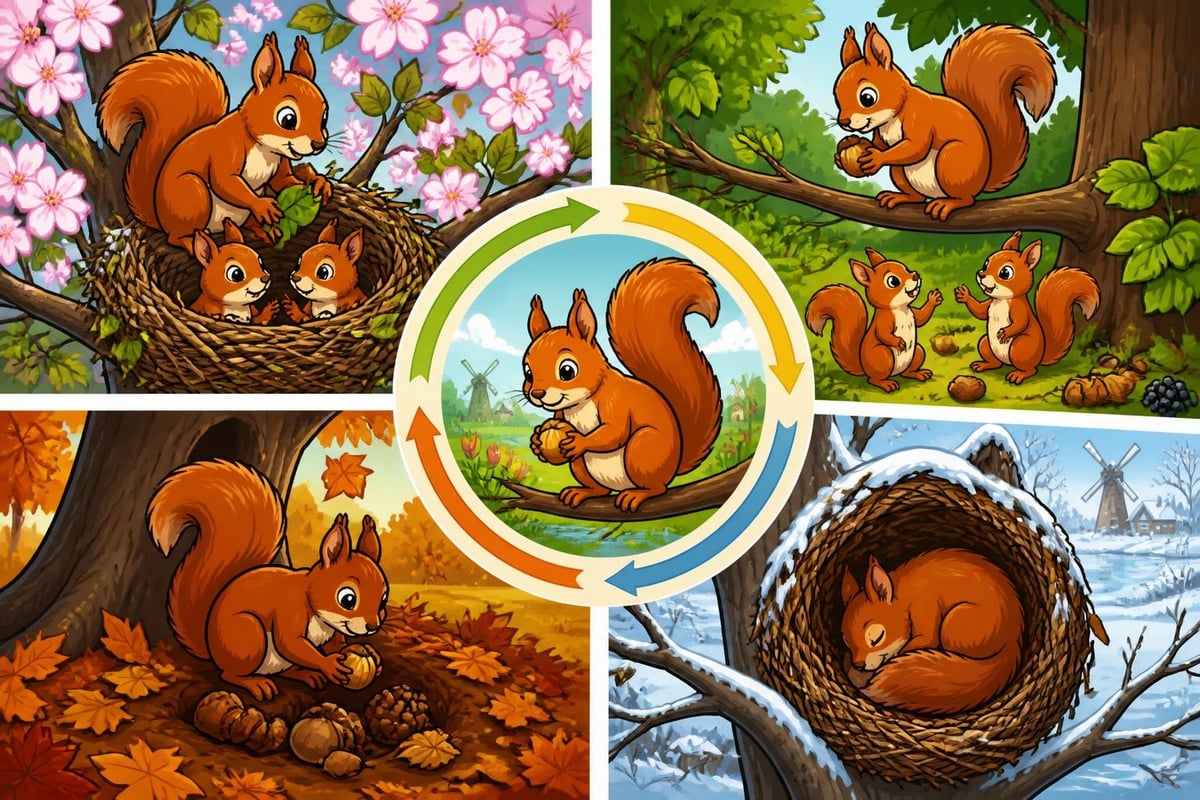
The life of a squirrel follows a fascinating annual calendar perfectly attuned to the Dutch seasons. Understanding this cycle helps us better support and appreciate these animals.
Spring (March–May):
The mating season begins with spectacular chases through the treetops. Males pursue females in what looks like a mad race. After a gestation of about 38 days, two to five young are born in a nest called a "dray". These nests are masterpieces of woven twigs, moss, and leaves.
Summer (June–August):
Young squirrels leave the nest and begin their acrobatic training. This is the season of plenty, when the squirrel indulges in insects, mushrooms, eggs, and young shoots. Their fur is at its reddest and most beautiful then.
Autumn (September–November):
This is when the great hoarding race begins. A single squirrel can hide up to 3,000 nuts and seeds during this period. Their weight can increase by as much as 20% to get through the winter.
Winter (December–February):
Although squirrels don’t truly hibernate, they drastically reduce their activity. They spend cold days in their nest, only coming out to retrieve hidden caches.
Season
Main activity
Food
Behavior
Spring
Mating & nest building
Buds, flowers
Territorial defense
Summer
Raising young
Insects, fruits
Lively and visible
Autumn
Gathering food
Nuts, acorns
Hyperactive
Winter
Survival
Stored supplies
Withdrawn
The squirrel in your backyard
Creating a squirrel-friendly garden is easier than you think. After years of observation and experimentation I’ve discovered what really works. Start with the right trees: oaks, beeches, hazel, and pines are favorites. A mature garden with these species becomes a squirrel paradise.
Practical tips for a squirrel-friendly garden
Feeding stations:
Place these at least 2 meters high and at least 3 meters away from shrubs where cats can hide. Fill them with unsalted peanuts, hazelnuts, and sunflower seeds. Avoid bread and processed foods.
Drinking water:
A shallow dish of fresh water placed in an elevated spot is crucial, especially during dry summers and harsh winters. Refresh the water daily.
Nesting sites:
You can buy or make special squirrel boxes. Hang them facing northeast to prevent overheating. An entrance of about 7-8 centimeters is ideal for red squirrels but too small for the larger gray species.
Squirrels and human culture
The fascination with squirrels goes beyond nature observation. These animals have carved out a special place in our culture and imagery. From children’s books to logos, the squirrel symbolizes foresight, playfulness, and natural wisdom.
In many cultures the squirrel is a symbol of preparation and planning. That association isn’t accidental: their behavior of storing supplies captures our imagination. For those who want to stay organized year-round, calendars with nature photos can provide daily inspiration. An animal calendar with beautiful nature shots brings that connection to nature into your home all year long.
Photographing squirrels
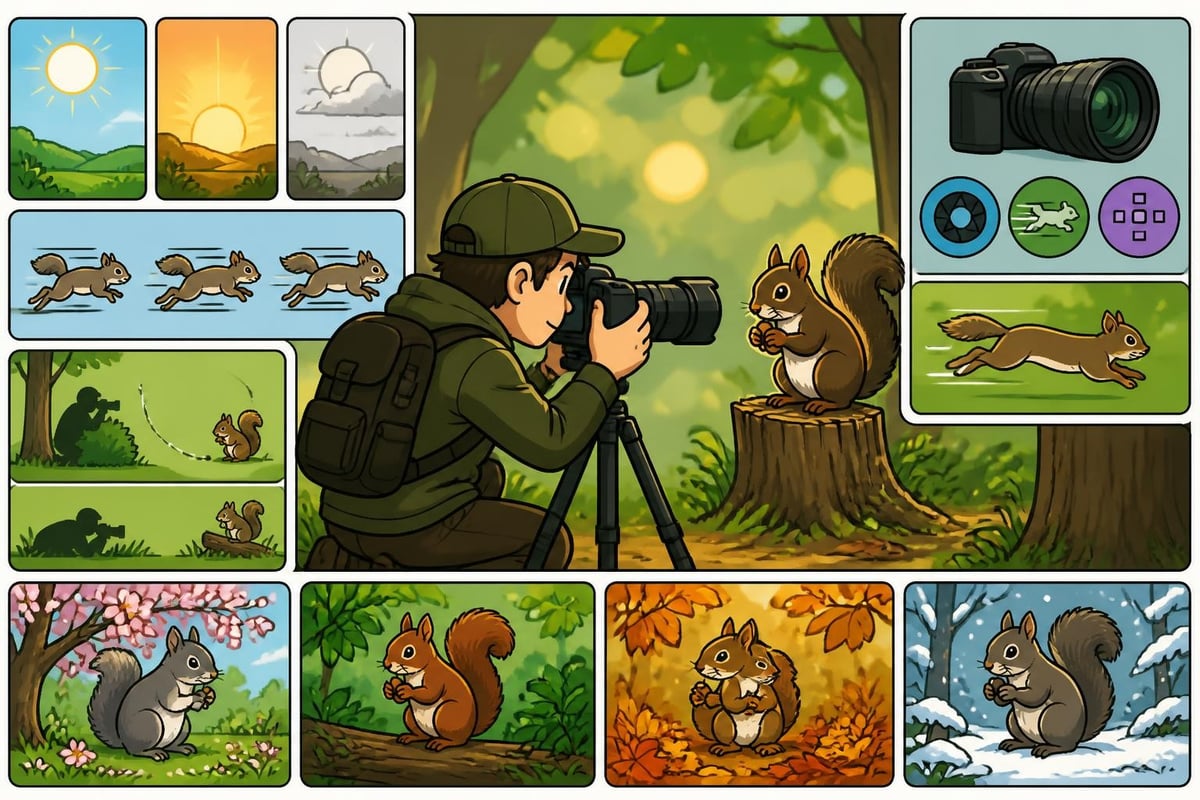
Capturing squirrels requires patience and preparation. The best photos occur in the early morning or late afternoon, when the light is soft and squirrels are active. Set your camera to a fast shutter speed (at least 1/500 second) to freeze their lightning-fast movements.
Photography tips:
Use a telephoto lens of at least 200mm
Look for predictable locations such as feeding stations
Wait patiently and move minimally
Pay attention to eye contact for emotional impact
Photograph at squirrel eye level for perspective
Threats and protection
Despite their adaptability, squirrels face various challenges in our modern world. Road casualties are a significant problem, especially in spring and autumn when young animals explore their territory and adults are busy foraging.
Main threats:
Habitat loss: Tree felling and urbanization destroy habitats
Road accidents: Thousands of squirrels are hit by vehicles each year
Pets: Especially cats pose a threat to young squirrels
Invasive species: The grey squirrel remains a potential threat
The Dutch research data show that citizen-science observations are crucial for conservation. By reporting your sightings, you contribute to important population data.
Living with squirrels
Not everyone is happy with squirrels nearby. They can dig up bulbs, raid bird nests, and even inhabit attics. But before taking drastic measures, there are humane solutions.
In case of nuisance:
Protect bulbs with chicken wire
Install metal bands around tree trunks to protect bird nests
Inspect and block access to attics and sheds
Use pepper-based scent repellents around vulnerable plants
It’s important to realize that squirrels are a protected species. It is illegal to catch or kill them without a permit. Moreover, removing one squirrel rarely solves the problem; another individual will quickly take the freed spot.
The future of the Dutch squirrel
As we look ahead to the coming years, there are reasons for both optimism and concern. Climate change affects the timing of food production in trees, which can lead to a mismatch between the birth of young and food availability. At the same time we see greater awareness and active conservation measures.
Urban green is becoming increasingly important as habitat. Parks, green roofs and gardens together form a network that squirrels can use as a corridor between larger natural areas. Every garden with native trees and shrubs contributes to this green network.
Positive developments:
Increasing awareness of biodiversity
More urban greenery and nature-inclusive building
Active monitoring by citizen scientists
Effective protection legislation
Growing populations in various regions
For nature lovers who want to follow these developments, Kalenderwinkel.nl offers various options. Their nature calendars for 2027 help you stay connected to seasonal changes and the natural cycle all year long.
Young squirrels: Care and assistance
Every spring wildlife rescue centers are overwhelmed with reports about young squirrels. Often human intervention is not needed, but sometimes it is. A young squirrel that has been alone for more than a few hours, feels cold, or is clearly injured needs help.
Recognize when a juvenile needs help:
Situation
Action
Urgency
Young calls and climbs on people
Back in tree, mother will retrieve
Wait 4-6 hours
Cold, no movement
Warm up, get immediate help
Immediately
Visible injuries
Do not touch, professional help
Within 1 hour
Eyes still closed, alone
Keep warm, expert help
Within 2 hours
If you find a needy young squirrel, place it in a closed box with a warm (not hot) heat pack wrapped in a towel. Contact a licensed wildlife rescue immediately. Do not give food or water without professional advice; this can do more harm than good.
The squirrel tells a story of resilience, intelligence and the eternal balance between people and nature. By living mindfully with these charming tree-jumpers we not only enrich their lives, but ours as well. For those inspired who want to experience this connection with nature daily, Kalenderwinkel.nl offers an extensive range of nature calendars and diaries for 2027. With convenient payment options and reliable shipping via PostNL, DHL or UPS, you can start the new year nature-conscious and organized.