Discover murdle, the addictive daily murder puzzle. Learn strategies, tips, and variants of this logical detective game that has millions of fans worldwide.
Every morning millions of puzzle lovers wait for the same moment: the new murdle appears online. It has become a ritual, much like flipping through a calendar to mark important dates. This daily murder mystery has taken the world by storm with its brilliant mix of logical thinking, deduction, and a touch of detective-romance. In this article I'll take you into the fascinating world of murdle, where you learn how to solve these puzzles, which strategies work, and why this game is so irresistibly addictive.
What exactly is murdle?
The name murdle is a pun on 'murder' and 'puzzle,' and that captures the concept perfectly. Every day you are served a new murder mystery to solve by logical reasoning. Unlike traditional detective stories, murdle is all about pure deduction.
The basic principles of the game
The game presents you with three elements you must unravel:
The culprit: who committed the crime?
The location: where did the crime take place?
The weapon: which murder weapon was used?
You receive clues in the form of witness statements. Each statement contains information that is true or false depending on whether the witness was involved in the murder. It sounds simple, but the complexity lies in combining all the information into one conclusive result.
Difficulty levels and variants
Murdle comes in different grades, from mini murdle to masterful challenges. Beginners often start with the simpler versions that have only three or four suspects. The expanded variants can, however, include ten or more suspects, with complex locations and an extensive arsenal of murder weapons.
Level
Number of suspects
Average solving time
Difficulty
Mini
3-4
5–10 minutes
Beginner
Medium
5-7
15–25 minutes
Average
Expert
8–10+
30–60 minutes
Advanced
Strategies for solving murdle
After solving hundreds of murdle puzzles, I've found certain strategies consistently work. It's not just luck, but methodical thinking and patience.
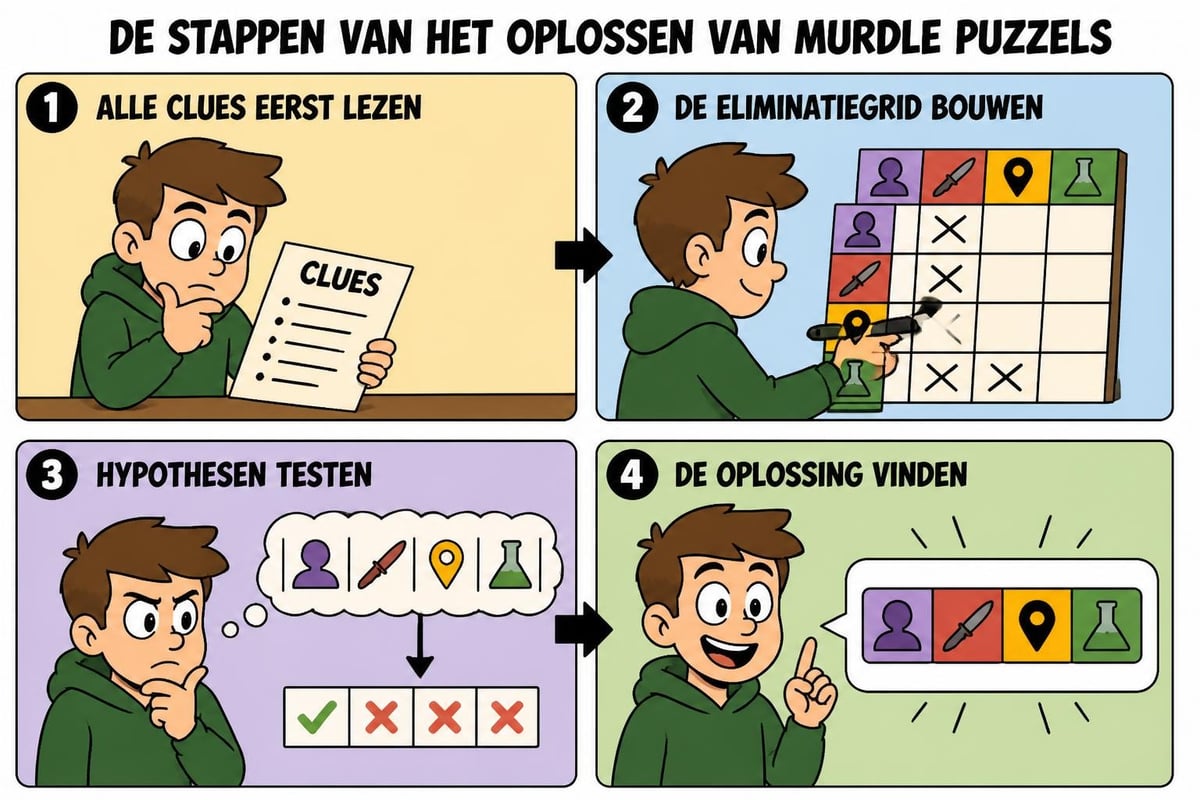
Start with the elimination grid
Your most important tool is your elimination grid. This is a table where you systematically track which combinations are possible or impossible. Make rows for suspects and columns for locations and weapons.
Whenever a witness statement rules out a combination, place an X in the grid. When you are sure something must be true, mark it with a check. This visual overview prevents you from forgetting or double-counting information.
Practical tips for your grid:
Always start with the most direct clues
Work from the outside in
Regularly cross-check your conclusions
Use different colors for certainties and possibilities
Read between the lines of witness statements
Every witness statement in murdle contains multiple layers of information. Sometimes a witness literally says what happened. Other times you must conclude what cannot be true.
A classic example: "I saw the murderer leaving the library with a candlestick." If this witness is innocent, the statement is entirely consistent. But if this person turns out to be the culprit, every element of the statement is suspicious.
Work with assumptions and test them
Often you reach a point where you have several possibilities. That’s when it’s time for hypothetical reasoning. Choose one assumption, for example: "Suspect A is the murderer." Work this assumption through your grid fully and see if it leads to contradictions.
The psychology behind murdle addiction
Why do people get so hooked on murdle? The answer lies in the perfect mix of challenge and reward. Just as people consult their birthday calendar daily for important dates, murdle becomes part of the morning routine.
Your brain’s reward system
Each time you correctly interpret a clue you get a small dopamine boost. Your brain loves recognizing patterns and solving problems. Murdle provides just enough resistance to stay challenging, but also enough moments of success to keep you motivated.
Neurological benefits:
Improves logical reasoning
Trains memory and concentration
Increases problem-solving ability
Provides mental relaxation
The social dimension
Murdle has created a lively online community. People share their solve times, strategies, and frustrations. The competitive element, without real pressure, makes it extra appealing.
Variants and similar games
The murdle formula has inspired countless variants and spin-offs. Each adds a unique twist to the basic principle of logical deduction.
Thematic murdles
Some versions use specific themes such as historical murders, literary mysteries, or even scientific riddles. These variants add extra context and background information that enrich the puzzle.
For fans of visual puzzles there are also combinations with imagery. Think of scenarios where you must analyze a map or reconstruct timelines. This is perfect for people who also enjoy traditional puzzles where patterns and details are essential.
Physical murdle books and cards
The popularity has led to physical products. Murdle books contain hundreds of puzzles you can solve on the go. These are ideal for people who like to puzzle during their commute or vacations.
Murdle in different languages and cultures
The murdle phenomenon is not limited to one country or language. Around the world people solve their murdles daily, with cultural differences sometimes leading to interesting variations.
Dutch murdle community
In the Netherlands, murdle has found an enthusiastic following. Dutch versions sometimes incorporate local elements like typically Dutch locations or cultural references. This makes the puzzles more recognizable and enjoyable for local players.
Popular Dutch adaptations:
Locations in well-known cities
Traditional Dutch weapons or objects
References to historical figures
Seasonal themes
The Dutch murdle community also organizes online events where players solve extra-difficult puzzles together. This shared experience strengthens the social bonds between puzzlers.
Advanced murdle techniques
For those who have mastered the basic techniques, there are advanced strategies that take solving to the next level.
Pattern recognition in witness statements
Experienced murdle players recognize certain patterns in how clues are worded. For example, when two witnesses claim exactly the same thing but use different phrasing, there is often a hidden contradiction.
Working with negative information
Sometimes what you are not told is more important than what is explicitly stated. If a witness says nothing at all about a particular location, that can mean that location is irrelevant or precisely crucial.
Technique
Difficulty
Effectiveness
Learning time
Elimination grid
Low
High
1 day
Hypothetical reasoning
Average
High
1 week
Pattern recognition
High
Very high
1 month
Negative deduction
Very high
Average
2 months
Optimize timing and speed
For competitive players every second counts. Some strategies help you work faster without sacrificing accuracy:
Scan all witness statements first before you begin
Identify the most informative clues first
Develop a fixed order in your thinking process
Train your brain to recognize patterns faster
Murdle as a daily habit
The power of murdle lies in daily repetition. Just as people use their calendar for 2027 to bring structure to their year, murdle gives structure to your day.
The best time to play
Different players have different preferences for when they solve their daily murdle. Some start with it as a mental warm-up with their morning coffee. Others use it as a midday break or evening relaxation.
The key is consistency. By playing murdle at the same time, it becomes an anchored habit that's easier to maintain. For those who like to have a drink while solving, a practical water bottle can be handy to stay hydrated during longer puzzle sessions.
Combining with other activities
Murdle fits perfectly into a broader pattern of daily mental training. Many people combine it with:
Other word puzzles and brainteasers
Language-learning exercises
Mathematical puzzles
Creative writing exercises
Common pitfalls and how to avoid them
Even experienced murdle players sometimes make mistakes. Recognizing these pitfalls helps you avoid them.
Drawing conclusions too quickly
The biggest mistake is assuming something is true without checking all possibilities. Murdle rewards patience and thoroughness. Even if something seems obvious, always verify it against all witness statements.
Forgetting or neglecting information
With more complex murdles you get a lot of information to process. Without a systematic approach you can easily forget a crucial clue. That's why a well-organized grid is indispensable.
Checklist to avoid mistakes:
Read each witness statement at least twice
Mark information you've used
Regularly check for contradictions
Take breaks during longer puzzles
Don't rely on your memory alone
Developing tunnel vision
Sometimes you become fixated on a single theory and ignore clues that point elsewhere. Stay flexible in your thinking and be willing to adjust your hypothesis when new information requires it.
The future of murdle
The murdle phenomenon is still growing. Developers are experimenting with new formats and technologies to enrich the experience.
Augmented reality and interactive versions
Future murdles could use AR technology where you "explore" physical spaces for clues. This would make the puzzle experience even more immersive.
Personalized difficulty levels
Artificial intelligence could generate murdles that adapt to your skill level. As you improve, the puzzles would automatically become more challenging.
Collaborative murdles
New variants could have teams collaborate on more complex mysteries that are too big for one person. This social element could further strengthen the community aspects.
Murdle for different age groups
One of Murdle's strengths is its accessibility for all ages. From children to seniors, everyone can enjoy these logic puzzles.
Murdle for children
Simplified versions introduce young children to logical thinking. With fewer suspects and clearer clues, they learn step by step to solve more complex problems. This develops critical thinking and analytical skills useful for school.
Murdle for adults
For adults, Murdle offers a welcome challenge that is both relaxing and stimulating. It's a way to keep your brain sharp without the stress of work or other obligations.
Murdle for seniors
Research shows that puzzles like Murdle can help maintain cognitive functions. For seniors, it's an enjoyable way to stay mentally active, with the added benefit of social interaction through online communities.
Why Murdle is more than a pastime
Murdle transcends the simple notion of a "game." It's a daily mental workout, a social connector, and a source of satisfaction. The skills you develop by playing Murdle are applicable to everyday life.
Transferable skills:
Systematically analyzing problems
Evaluating multiple sources of information
Patient and thorough work
Creative thinking within constraints
Just as keeping a yearly calendar helps you stay organized, Murdle helps you think in a structured way. It teaches you that complex problems can be solved by breaking them down into smaller, manageable pieces.
The magic of Murdle isn't just in solving the puzzle itself, but in the journey to get there. Every mark in your elimination grid, every breakthrough in your reasoning, every "aha!" moment builds your confidence and problem-solving ability.
Murdle combines the best of logic puzzles with the thrill of a detective story. Whether you're a seasoned puzzler or just starting out, there's always something new to discover in this fascinating world of deduction and mystery. For those who value structure and planning, Kalenderwinkel.nl offers an extensive range of calendars and planners for 2027, so you can perfectly schedule your daily Murdle routine. With convenient payment options and reliable shipping via PostNL, DHL, or UPS, you'll quickly get the tools to start your year organized.