Are you looking for a puzzle enthusiast or a beautiful jigsaw puzzle? Read how many pieces suit you, which image will keep you captivated, and what to look for when choosing.
Someone searching for "puzzelman" is usually looking for a puzzle with a colorful figure, like a peddler, or for the puzzle associated with Dutch puzzling: a jigsaw with enough pieces and an image you want to look at for weeks. The good news is the choice is smaller than it seems. If you match the piece count, subject, and the space on your table, choosing a puzzelman becomes much easier.
This article helps you choose, from the first piece to the last border. You can read how many pieces suit which level, how to start a puzzle, and which images are worth it.
What do people mean by "puzzelman"?
By "puzzelman" searchers usually mean a jigsaw with a recognizable character or a busy scene. Think of a traveling hawker with his cart full of goods, or the bustling village scenes that have been popular in the Netherlands for decades.
The word is not a fixed product name. Some people search for a specific puzzle, others just want inspiration for a cozy puzzle night. That actually makes choosing more fun: you don't have to know what you're looking for, you only need to know how you want to puzzle.
A good puzzle has three things. The image is rich in detail so you keep discovering new pieces. The colors differ enough to sort them. And the pieces fit together firmly so an almost finished puzzle doesn't fall apart when you move the table.
What kinds of puzzles are there?
Jigsaw puzzles can roughly be categorized by piece count, image, and type. The piece count determines the difficulty, the image determines the enjoyment, and the type determines how you puzzle.
The common types at a glance:
Classic jigsaw puzzles of 500, 1000, or 2000 pieces, laid flat on the table
Children's puzzles with large pieces or a shape to fit into
Panorama puzzles that are very wide and show a landscape
3D puzzles that form a building or object
Themed puzzles, such as animals, cities, art, or fairy tales
If you're looking for a puzzle that also works as decoration, look for images you would happily hang on the wall. The same illustrators and themes that appear in calendars also show up in puzzles. A calendar with birds or landscapes and a puzzle with the same subject pair nicely in a reading nook or living room.
How many pieces suit you?
The number of pieces you choose depends on how much time you want to spend and how much experience you have. A puzzle guide from Puzzles Galore advises beginners to start with 500 pieces and lists 1,500 to 2,000 pieces as a possible challenge for those who puzzle regularly.
The same guide also gives a time indication. A 500-piece puzzle can take about an evening, while a 2,000-piece puzzle can take a week or longer. Those differences are important, because a puzzle that’s too large and sits unfinished for weeks can become more pressure than pleasure after a while.
Overview of puzzle sizes: 500 pieces can take about an evening and suits beginners, 2000 pieces can take a week or longer.
A few rules of thumb for choosing:
New to puzzling: start with 500 pieces and an image with clear color blocks.
Occasional puzzler: 1000 pieces is the classic size and usually fits on a dining table.
Experienced puzzler: 1500 to 2000 pieces, with a highly detailed image.
Little table space: choose a smaller size or place the puzzle on a foldable puzzle mat.
On a table of normal size a 1000-piece puzzle generally fits fine. When in doubt, always check the depicted dimensions on the product page.
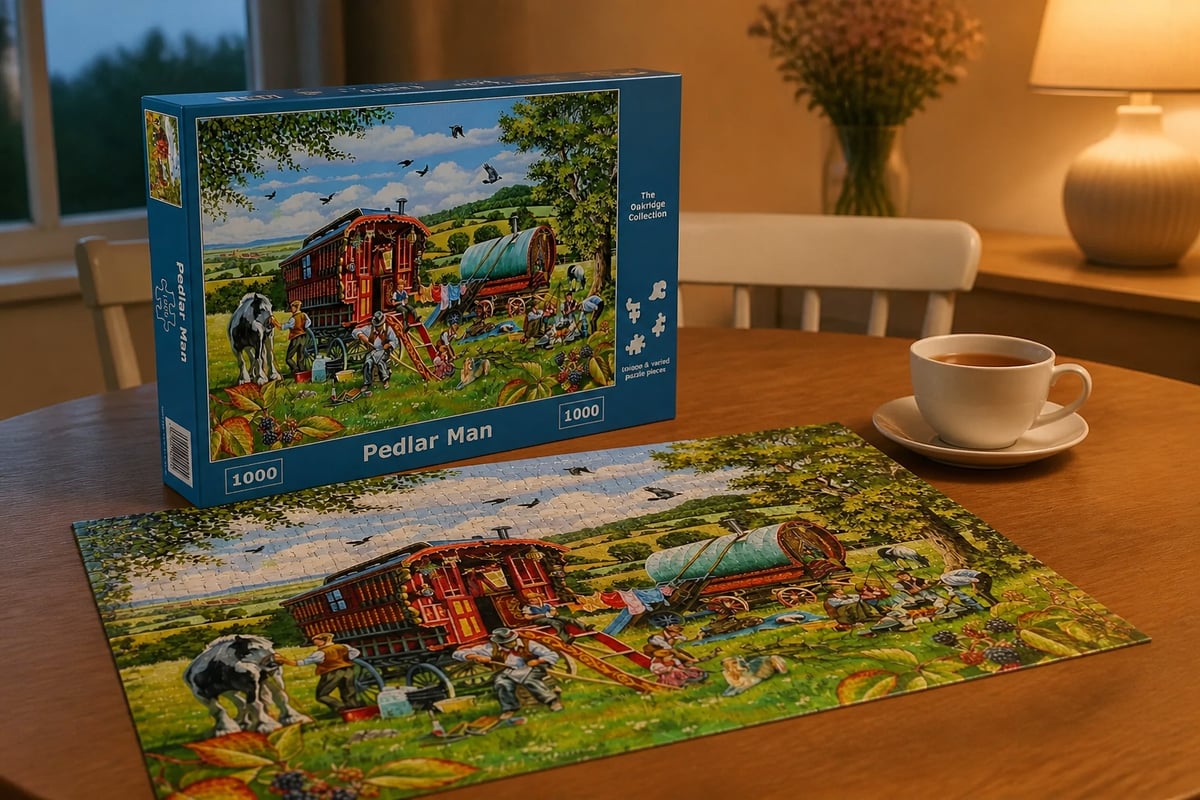
A puzzle-man with 1000 pieces: the Pedlar Man
A good candidate if you’re looking for a puzzle-man is the Pedlar Man puzzle. A travelling vendor is a grateful subject. His cart and clothing are full of different colors and objects, so you can nicely sort the pieces by motif, for example everything with the cart’s goods in one tray and the background in another.
The Pedlar Man Puzzle with 1000 pieces has 1000 pieces and a nice finish. For anyone looking for a medium-sized puzzle that fills an evening or a weekend, this is a pleasant size. It gives you enough to really get into it, but you won't lose sight of it for weeks. Start with the border, then build the figure itself and save the uniform background pieces for last. That way you keep the feeling of progress the longest.
How do you make a puzzle?
You finish a puzzle fastest by starting with the edges and then working by color or element. A fixed order prevents you from spending hours looking for the same pieces.
This is how to go about it:
Take all the pieces out of the box and lay them face up.
Find the edge pieces with a straight side and build the frame.
Sort the rest by colour or pattern into bowls or on trays.
Work by area: start with the part that has the most recognizable details.
Try pieces by shape, not just by colour, if you get stuck.
Take breaks: a fresh perspective often immediately reveals what you missed before.
A tip many puzzlers share: keep the box nearby. The picture on the lid is your best aid if you lose sight of the whole.
Steps to start a puzzle: flip the pieces over, find the edge pieces, sort by colour, work by area, and take breaks.
What are the best jigsaw puzzles?
The best jigsaw is the puzzle whose image keeps you engaged until the last piece. That varies by person, but there are qualities that almost always matter: sharp printing quality, sturdy cardboard, and an image with enough variation.
A few themes that work well, with examples from Kalenderwinkel.nl's range:
When choosing, look not only at the picture but also at how you will use it. If you want to puzzle with two people, an image with several distinct areas works better than a monotonous landscape.
Puzzling with children: which age suits which puzzle?
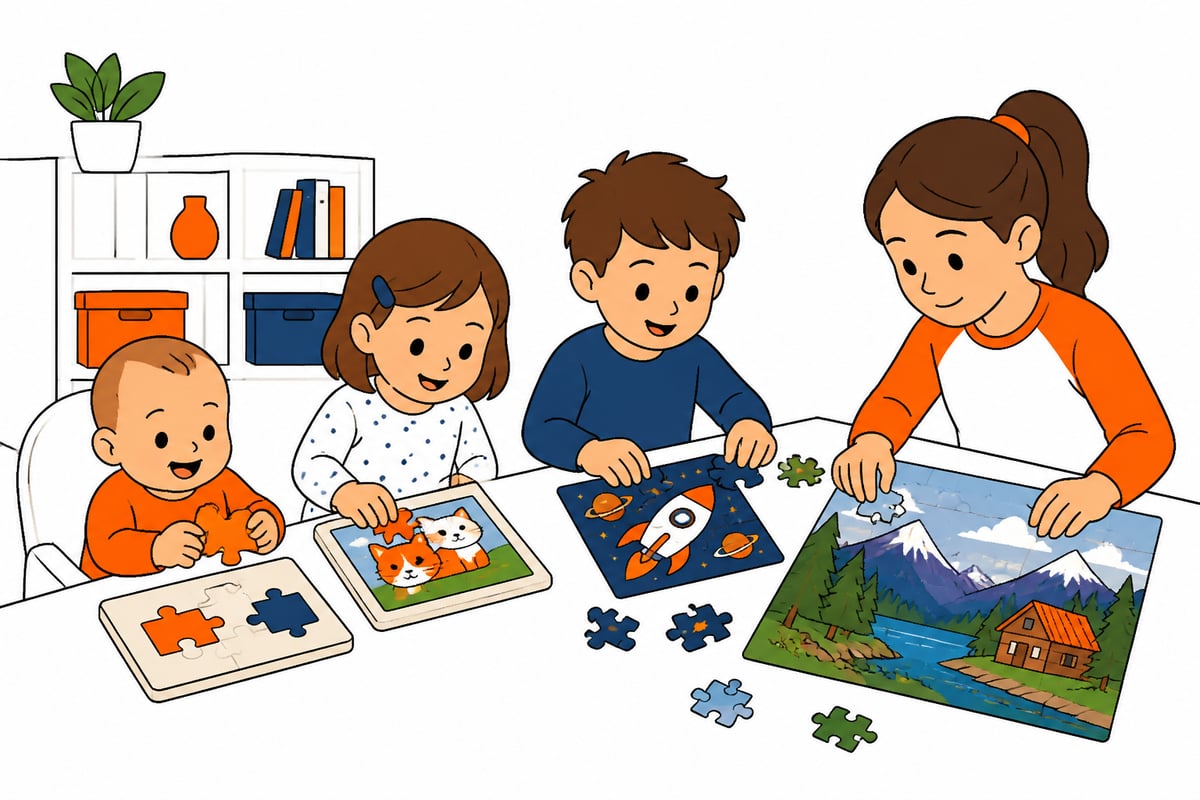
For children, the number of pieces increases with age. An age guide from Speedcube.nl recommends for 1 to 2 years simple puzzles with 2 to 4 large pieces, for 2 to 3 years 4 to 6 pieces, and for 3 to 4 years 12 to 24 pieces.
After that it goes faster. The same guide suggests 25 to 48 pieces for children aged 4 to 5 and states that from age 5 you can introduce more complex and 3D puzzles. A child who is given a puzzle that's too difficult too soon often loses interest, so it's worth starting slightly below their level. Success makes them want more.
If you prefer a quiet puzzle evening yourself, a child can join by finding edge pieces or sorting pieces by color. That way puzzling becomes something the whole family does.
Why puzzling feels good
Puzzling works for many people as a moment of calm: your phone goes aside, your hands are busy and your mind can focus on one thing. You look for an edge, try a piece, it fits or it doesn't. Such a small, manageable goal makes an evening on the couch remarkably peaceful, especially after a day full of notifications and long to-do lists. In addition, research places puzzling in a broader context. A 2026 article in The Conversation reports that mentally stimulating activities, including puzzles and crosswords, were associated with a lower risk of frailty among the participants studied.
That's an association and not a guarantee that puzzling reduces this risk. But as motivation to put a puzzle on the table, it's a nice bonus on top of the usual enjoyment. If you want to keep it cozy, put a cup of tea next to it and leave the puzzle for a few days. Each time you pass by, add a handful of pieces without rushing. That small, visible progress is for many puzzlers exactly what makes it so pleasant.
Puzzle and calendar: a cozy combination
A puzzle and a calendar both stand for time you take for yourself. Those who choose a puzzle in the autumn often plan the new year at the same time. A 2027 calendar that matches your puzzle's theme completes the whole.
A puzzle of a city or landscape next to the Amazing Places calendar 2027
A busy, humorous scene next to the Jan van Haasteren notebook calendar 2027
It's a small effort, but it immediately gives a living room or workspace a cohesive look.
How to buy a puzzle you will actually finish
You choose a puzzle you will actually finish based on three things: time, space and subject. That sounds simple, but it's exactly where many puzzlers go wrong.
Time. Using the guideline of one evening for 500 pieces and a week or more for 2000 pieces helps you choose realistically. If you have two busy weeks ahead, don't choose the largest one.
Space. If you lay out the puzzle on the dining table, you need to be able to eat there in the evenings. A puzzle mat or a board to store the puzzle on solves that.
Subject. Choose something that makes you happy. A puzzle of a subject you already like, such as your own pet, your favorite country or an old illustration, will keep you engaged longer than an image you chose only for the challenge.
If you order from Kalenderwinkel.nl, it's useful to know that orders placed on weekdays before 16:00 are shipped the same day, shipping within the Netherlands is free from €49, and returns are free. If you have a question about a puzzle, customer service will help you on weekdays via WhatsApp or email.
FAQ
Where is the "puzzelman"?
The "puzzelman" is not a fixed place but a search term for a jigsaw puzzle with a colorful character or a busy scene. You can find such puzzles at specialized webshops, for example in the puzzle assortment of Kalenderwinkel.nl.
How many pieces should a beginner choose?
A beginner is best to start with a puzzle of about 500 pieces, which typically takes around one evening. After that you can progress to 1000 pieces and later to 1500 or 2000.
Can I have a puzzle made with my own photo?
Kalenderwinkel.nl sells standard puzzles with a fixed image. A puzzle with your own photo cannot be ordered there.
Start today with a small step: decide how many evenings you want to puzzle and choose the piece count accordingly, for example the Pedlar Man Puzzle with 1000 pieces for a cozy weekend. Kalenderwinkel.nl offers, besides puzzles, a wide range of calendars, planners and cards, with reliable shipping via PostNL, DHL or UPS and convenient payment options. If you want to combine the puzzle with a calendar that matches your interior, you can view the full range and calmly pick your favorites on Kalenderwinkel.nl.