What is a sloth, what does it eat and why does it move so slowly? Read the key facts about this animal, plus ideas for a sloth calendar.
A sloth is an arboreal mammal from the rainforests of Central and South America that spends almost its entire life hanging upside down in the branches and moves extremely slowly. That pace is not laziness but a clever survival strategy: the sloth eats low-nutrient leaves, keeps its energy use low and therefore is hardly noticed by predators. Below you can read everything a beginner wants to know about the sloth, from its body and diet to its threats.
What exactly is a sloth?
A sloth is a mammal that belongs to the group of Xenarthrans, together with anteaters and armadillos. There are two families: two-toed and three-toed sloths. Those names refer to the number of claws on the front limbs, because on the back all sloths have three.
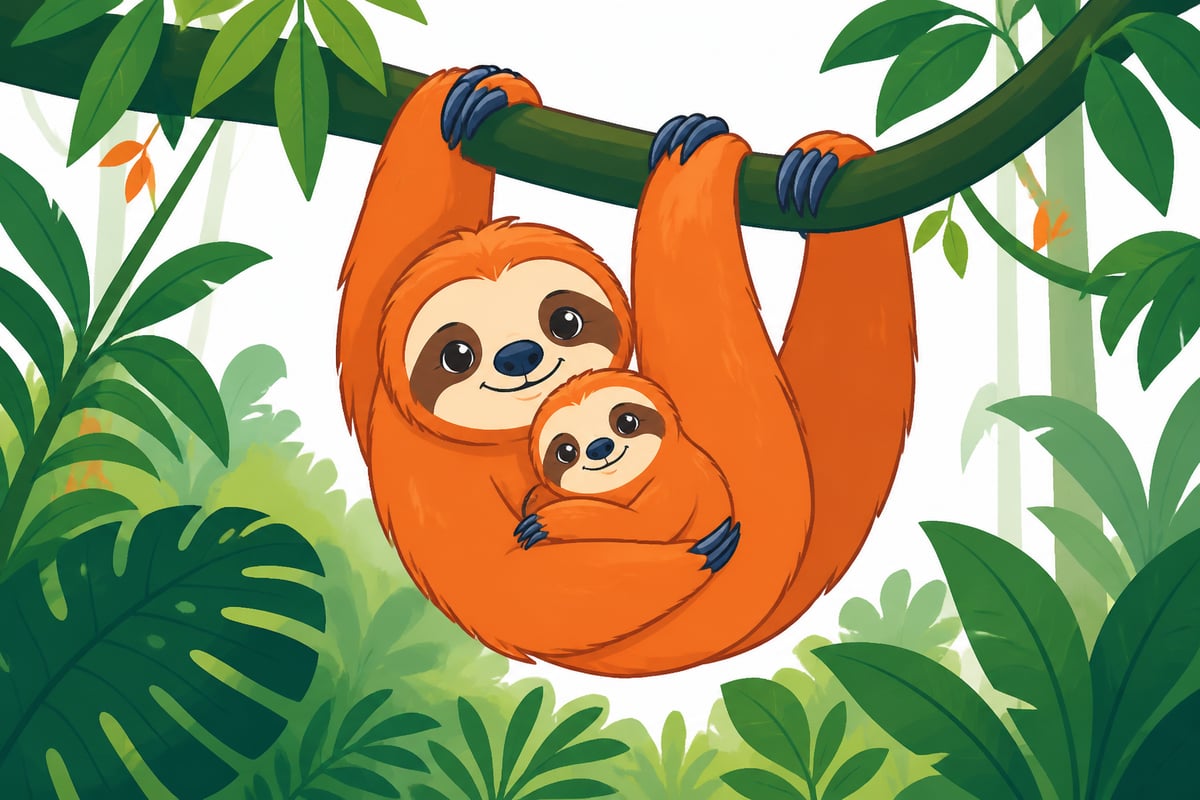
You find sloths in tropical forests from Honduras to Brazil. They spend almost their entire lives in the treetops, where the canopy shelters them. Most species are about the size of a cat or a medium-sized dog.
When you see a sloth, you first notice that friendly face. The dark patch around the eyes and the light, wide mouth give the animal a perpetual smile. That's part of why this animal is so popular, and why you see it so often on posters, puzzles and calendars.
How does a sloth live?
A sloth lives solitary, hanging from its four clawed limbs, and almost never leaves the tree. It sleeps, eats and rests in the same spot. According to WWF-Rangers, a sloth sleeps about 8 to 9 hours a day, so less than you might expect from an animal with this reputation.
The daily range is small. WWF-Rangers cites a distance of about 38 meters per day. That's roughly the length of a swimming pool, spread over a whole day through the branches.
A life upside down
Hanging is the sloth's normal posture. Its claws act like hooks, so it needs hardly any muscle power to stay attached. Even when a sloth sleeps, it remains hanging.
Its fur even grows from belly to back, exactly the opposite direction of most mammals. That way rainwater easily runs off the animal while it hangs upside down.
A whole world lives in that fur. Algae give the coat a greenish tint, making the animal less visible among the leaves. Insects also live in the fur — a small ecosystem on a single animal.
On the ground it's difficult
On the ground the sloth is much less in its element. Its legs are made for grasping, not for walking. According to WWF-Rangers, a sloth crawling on the ground does not move faster than 2.5 meters per minute.
Yet the sloth is a surprisingly good swimmer. In water it moves better than on land and even crosses rivers.
Why is the sloth so sluggish?
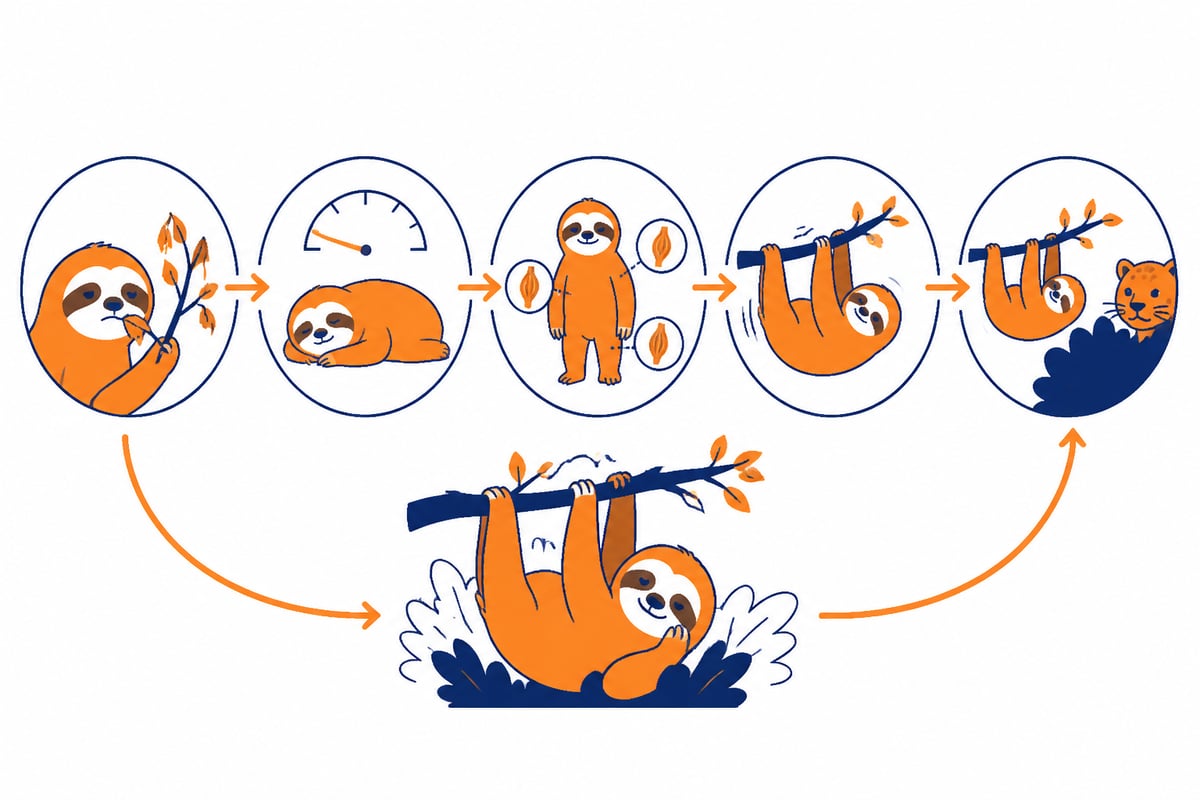
The sloth is so slow because its diet yields almost no energy and it therefore has to conserve its strength. Leaves are a meager food, and moving slowly is the way to survive on them.
Added to that, a sloth has little muscle mass. A large, muscular body would demand too much food, so nature keeps it modest. Those who use little need to eat little.
The metabolism fits that approach. Digestion is extremely slow, and that is the core of the whole story. The Nat Geo Junior site offers an accessible explanation of how the sloth’s claws and organs are adapted to a life in the branches.
What does a sloth eat?
A sloth eats mainly leaves, supplemented by buds, twigs and sometimes fruits or flowers. It is a herbivore with a very narrow menu. Many sloths choose a handful of specific trees in their area and keep returning to them.
Digesting that food is a matter of patience. According to National Geographic Netherlands, processing a single leaf can take a sloth up to a month. The animal’s stomach is large and has multiple compartments, in which bacteria slowly break down the tough plant material.
Because of that slow pace a sloth almost always feels full, even though it gets little energy from its meal. It is a balance that has worked for millions of years.
Down once a week
There is one time when the sloth does leave its tree. About once a week it descends to defecate, WWF-Rangers report. It digs a small hole at the base of the tree and covers it again.
Biologists suspect this behavior is related to the trees it eats and the fur ecosystems that live on it. What the exact reason is remains the subject of research. It is however the most dangerous moment in a sloth’s life, because it is then on the ground, where predators lie in wait.
Sloth facts at a glance
If you want to get to know the sloth quickly, find the main facts below at a glance.
Habitat: rainforests of Central and South America
Types: two-toed and three-toed sloths, with two or three claws on their forelimbs
Diet: leaves, buds, twigs and sometimes fruit
Sleep: about 8 to 9 hours per day, according to WWF-Rangers
Daily distance: about 38 meters
Speed on the ground: up to 2.5 meters per minute
Digestion: one leaf can take up to a month
Swimming: a surprisingly good swimmer
One special fact concerns the neck. The three-toed sloth has extra neck vertebrae, allowing it to turn its head far, up to about 270 degrees. This lets it look around without moving its whole body.
Why doesn't a sloth get a red face?
A sloth doesn't get a red face because its body is built to hang upside down. The organs are attached to the breastbone and ribs, so they do not press on the diaphragm. This keeps breathing possible even if the whole body hangs by the head.
It's different for humans. If we hang upside down for a long time, the belly and organs press against the diaphragm and deep breathing becomes a struggle. The sloth doesn't have that problem because its insides are, as it were, suspended and do not rest on the respiratory muscle. A slow metabolism and low energy use help: the heart does not have to pump blood upward with much force, because the animal rarely exerts itself.
The result is an animal that can hang for hours without experiencing high blood pressure in the head. Consider the roughly 8 to 9 hours of sleep per day that a sloth gets according to WWF-Rangers: it simply spends that time on the branch, without waking up uncomfortable or dizzy. It's one of those adaptations by which nature turns an apparently awkward posture into the most comfortable one.
Can you pet a sloth?
You should not pet a sloth, because it is a wild animal that experiences stress from touch. What looks so cuddly is a threat to the animal. A sloth has a sensitive body and responds poorly to unnecessary disturbance.
Also, those long claws are not toys. They are made for gripping, and a sloth that feels threatened can strike with them. If you want to experience this animal up close, it's safest to do so through a reputable rescue center focused on rehabilitation and return to the wild, or via photos and nature films.
The sloth's forest is threatened
The biggest threat to the sloth is the loss of its forest. Because the animal hardly leaves the tree and moves so slowly, it cannot flee quickly when trees are cut down. Deforestation for agriculture, roads and logging shrinks its habitat and fragments it.
That has direct consequences. A sloth that wants to move from one tree to another often has to cross the ground, where he is vulnerable to traffic, dogs and predators. Power lines also pose a risk to animals that climb along branches and cables.
Those who want to help can choose products made from certified wood and paper, and support conservation organizations that protect rainforests. That way everyone contributes on a small scale to the preservation of this remarkable animal.
Another word for sloth
Another word for sloth is a lazy person, a layabout or a loafer, and when people refer to the animal they sometimes use the name Bradypus for the three-toed species. The term is also used figuratively in Dutch for someone who has no motivation.
You can also encounter the word in other forms. When filling in a crossword, for a three-toed sloth with two letters you might look for "ai", the name the animal is commonly known by. In conversation you sometimes still hear "luiwammes" or "luie donder" for a person who lies on the couch all day, and the comparison to the animal is then made immediately.
That image is unfair to the animal itself. The sloth is not a slob but an energy-efficient specialist who does precisely what his body and environment require. According to WWF rangers, he moves about 38 meters daily and sleeps only 8 to 9 hours, which for an animal that can take a month to eat a single leaf is by no means extreme. A little admiration for his equanimity is therefore warranted.
Bringing a sloth into the home via the calendar
Bringing a sloth into your home is fine, provided you choose a calendar or planner instead of a live animal. For anyone who wants to see that cuddly face every day, a wall calendar is a cozy way to start and keep track of the year.
Kalenderwinkel.nl has several calendars featuring this subject for 2027. The Sloth calendar 2027 showcases the animal each month. Those who prefer a larger size can look at the Sloth A3 calendar 2027, which gives extra space to every photo. There is also the Sloth Yoga calendar 2027, featuring sloths in playful yoga poses that bring a smile, also available as a mini version.
For the animal lover with a double plan
Do you like multiple animals at once? Then an Avonside Sloth calendar 2027 fits nicely alongside other animal themes. Kalenderwinkel.nl has a wide and special assortment, making it easy to find a calendar that suits your kitchen, workspace, or child's room.
A nice gift idea: give a sloth calendar to someone who could use some calm. That way the year plan is also a small encouragement to take things a bit more slowly.
Another cozy animal from the same vibe is the capybara, the calmest rodent in South America. If you enjoy puzzling, you can lose yourself in the cheerful Patterned Capybara Puzzle of 1000 pieces, with which you build an image of 68 x 48 cm.
FAQ
What is a three-toed sloth with 2 letters called?
A three-toed sloth with two letters is called an "ai". That is the name by which the three-toed sloth is also known, and the word often appears in crossword puzzles. The name is derived from the high cry the animal makes.
How long does a sloth live?
In the wild, sloths often live for decades, although this varies by species and habitat. The exact age is difficult to determine because the animal lives hidden in the treetops. Threats like deforestation and traffic can significantly shorten their lifespan.
Are sloths dangerous to humans?
Sloths are not aggressive, but they are still wild animals with sharp claws. If they feel threatened, they can defend themselves with their claws and by biting. Always keep your distance and leave the animal alone.
Take a look at the wall you’ll pass every day next year and think about what image you’d like to see there. Maybe a friendly sloth fits perfectly with your yearly plan, or a cozy puzzle like the Patterned Capybara Puzzle 1000 Pieces for the long evenings. If you order before 4:00 PM on a working day, your package will be dispatched the same day, and shipping within the Netherlands is free from €49. If you want to browse calendars and planners at your leisure, Kalenderwinkel.nl is happy to help, so check out the range and choose the calendar that adds color to your year.